Category: Church Politics

First Email from the 2009 Episcopal Convention

Dear Family and Friends,

The General Convention is a window into the Episcopal Church.

The exhibit hall is one example.  We see the foolish expenditure of lavish booths — some with piles of silver and gold chalices costing thousands and thousands of dollars — displayed in architecturally marvelous booths.  There are also booths of indigenous people around the world selling various items to support their very lives.  There are a few progressive movers and shakers — troublers of Israel — who want justice to flow in every direction.  And sales of Bishop’s Blend Coffee to help poor coffee farmers.  Publishers sell mostly expensive books on prayer, bible study, and self improvement.

The debates have been thoughtful and generous — as far as I have seen.  Bobby Dellelo has covered the House of Deputies.  I am now in the House of Bishops as they debate the possibility of studying possible liturgies for blessing same gender couples.

I fear that the General Convention will — inadvertently — condone torture INSIDE American jails, prisons, and immigration detention centers.   The unintended consequences of C020′s silence on torture in America is, in fact, condoning torture in America.

Here is the current resolution against torture — C020.

CURRENT VARIANT
/Resolution:/    *C020*
/Title:/    *Condemnation of Torture*
/Topic:/    *Human Rights*
/Committee:/    *09 – National and International Concerns*
/House of Initial Action:/    *Deputies*
/Proposer:/    *Diocese of Newark*

————————————————————————

/ Resolved,/ the House of Bishops concurring, That the 76th General
Convention condemn the use of torture and the practice of extraordinary
rendition by the United States and any government, individual or
organization in any location in the world; and be it further

/Resolved, that Episcopalians shall not engage in, order, or assist in
the torture of any human being, and shall not counsel the use of torture
for intelligence gathering or any other purpose; and be it further/

/Resolved, that lawyers who are Episcopalians and dioceses are urged to
procure or provide pro bono legal counsel to help defend any
Episcopalian in military, police, civilian governmental or contractor
service who faces discharge or disciplinary action for refusing to
order, engage or assist in torture, or for refusing to approve or to
provide counsel justifying the use of torture for any purpose, or who
faces discharge or disciplinary action for exposing such practices; and
be it further/

/Resolved/, That the General Convention call upon the United States
government, and all governments, individuals and organizations in any
location in the world to comply with Geneva Conventions and the United
Nations’ Universal Declaration of Human Rights and the administration of
Justice, enacting policies to prevent its use /the use or torture and
/extraordinary rendition both domestically and abroad/; and be it further/

/Resolved, that the General Convention call upon the President and
Congress to devise and implement truth and reconciliation-based methods
of accountability to make transparent to the American people
governmental practices or torture and extraordinary rendition./
Members of the National and International Issues legislative committee told me that it does not refer to torture in our jails, prisons and immigration detention centers.

—————————————————————————–
So we have asked a few bishops and a few deputies to add the following phrase to C020:

including American jails, prisons and immigration detention centers

Sadly enough — if they only condemn FOREIGN torture they are offering silent acceptance of domestic torture.  They will have failed to consider Sheldon Weinstein — attacked in his cell on April 20, 2009 in a Maine Prison.  He was a sex offender.  The guards left his cell door open.  Guards are aware that sex offenders are often killed by other prisoners.  He was kicked in the groin over and over again.  He died four days later. Nothing new.  Just what happens in prison.

One can see Maine guards Macing a naked prisoner in the face after he is strapped into a restraint chair.  It’s on the web at:  CLICK HERE

A BBC documentary shows torture in jails and prisons all over America:  http://novakeo.com/?p=109

Some things have really helped our cause:

Last night Malcolm Boyd gave a DYNAMIC poetry reading backed by inspired jazz musicians — guitar, piano and drums.  The reading was held in the Jazz Kitchen, a Disneyland bar.  Boyd was flying high — soft gentle poems in loving phrases — loud strident rhythms of painful subjects.  Boyd explained about torture INSIDE America — and recited the poem in the second attachment.  He wrote this poem in response to a request from Katrina’s Dream — about torture in American prisons and about Bobby Dellelo.  For a press release about Boyd –  CLICK HERE

On Sunday Bobby Dellelo gave a moving personal talk as one of the Consultation speakers.  Ed Rodman introduced him and led a question session afterwards.  People listened to Bobby and asked good questions.

Now it is late at night.  Time for sleep.

Blessings always,

George

The Poem Challenges Torture

Katrina’s Dream published a new poem today by Malcolm Boyd about torture in American prisons.  The poem connects torture in our American jails and prisons with Jesus’ suffering.  The publication is timed to encourage the Episcopal Convention in Anaheim this July to pass a resolution asking Congress to outlaw torture in American jails and prisons.  It is on the internet at http://www.opinion.katrinasdream.org/?p=114

Change Us
By Malcolm Boyd
We’ve mainstreamed torture, haven’t we, Jesus?  Turned it into just another word in the clutter of everyday news.  Not something to work up any sweat about.  It seems to me our worst sin is to torture people who are already in our power as prisoners.  Like people in our prisons.  Like Bobby Dellelo.
The 33 years you spent with us here, Jesus, including when we nailed you, still hasn’t taught us what we need to know about love and justice, has it?  Our prison system seems an agonizing and endless system of crucifixion.  Why don’t we wake up, Jesus?  Prison torture is torture of flesh and blood beings.  It’s not unlike our torture of you when you dwelt among us.

Please convert us, Jesus, to work against prison torture.  Change us into community organizers for peace, justice, nonviolence and your love.  Thank you, Jesus.


Boyd, 86, is poet/writer-in-residence at the Episcopal Cathedral Center of St. Paul in Los Angeles.  After a career in Hollywood and television, Boyd, was ordained an Episcopal priest.  He founded a college coffee house in Colorado and opposed segregation in Louisiana in 1959. He joined 27 other Episcopal priests, Black and white, in a Louisiana Freedom Ride in 1961, and registered voters in Mississippi and Alabama in 1965, the year “Are You Running with Me, Jesus?” was published.  A fortieth anniversary edition has been published with additional poems.

In 1966 national media reported on his gig reading prayers and his dialogue with audiences about God in the San Francisco nightclub, the hungry i.  He performed with Dick Gregory, Vince Guaraldi and Charlie Byrd.  The New York Times wrote, “Malcolm Boyd is a latter-day Luther or a more worldly Wesley, trying to move religion out of ‘ghettoized’ churches into the streets where people are.”  In 1968 Boyd was with Martin Luther King, Jr. in a nonviolent protest against the Vietnam War inside Arlington Cemetery, directly below the Tomb of the Unknown Soldier.  He was arrested in the Pentagon for being part of a Peace Mass protesting the Vietnam War.

Bobby Dellelo, 67, spent 40 years of his life in reform schools and prisons, five years in solitary, with three escapes.  He works on the American Friends Service Committee Criminal Justice Program.  He was featured in the March 30, 2009, New Yorker Article “Hellhole” about torture in solitary confinement.

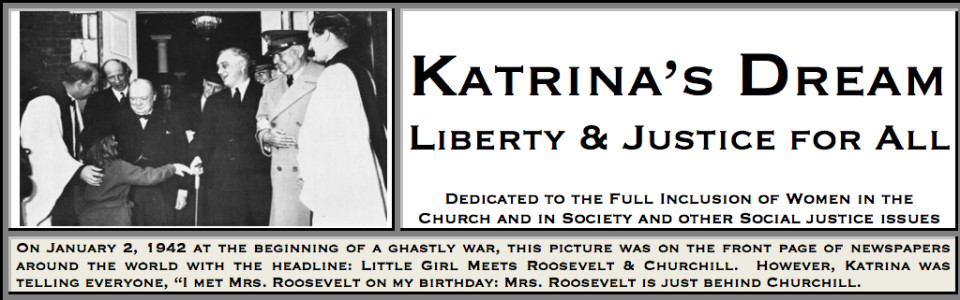
Katrina’s Dream was founded in memory of the late Katrina Martha Swanson, one of the “Philadelphia Eleven” ordained priest irregularly in 1974.  When the Equal Rights Amendment was voted down, Katrina always said the Pledge of Allegiance, “With Liberty and Justice for Some.”  Katrina’s Dream is dedicated to the full inclusion of women in society and Liberty and Justice for All.
Among other justice issues, Katrina’s booth at the Episcopal Convention will support a resolution that “requests the Congress of the United States to prohibit torture including long-term solitary confinement and every cruel, inhuman or degrading treatment of prisoners in all prisons, jails, and other places of confinement within the United States, or any place subject to their jurisdiction, following the definition of torture in the United Nations Convention Against Torture and Other Cruel, Inhuman or Degrading Treatment or Punishment.”  Bobby Dellelo will help staff the booth at the Episcopal convention and speak at the legislative hearing on the resolution which he helped write.

Contacts
Katrina’s Dream:   George Swanson,   415 464 7744,  george@katrinasdream.org
Malcolm Boyd:    malcolmboyd@ladiocese.org
Boyd is on the web at
http://malcolmboyd.com/nineties.htm
Bobby Dellelo:   339 226 0475,   bdellelo@yahoo.com
Dellelo is described in the New Yorker Article “Hellhole”
Click Here

A Resolution for General Convention on Indigenous Peoples

Title: Repudiation of the Doctrine of Discovery

Resolved, the House of _____________ concurring, That the 76th General Convention direct The Most Rev. Dr. Katharine Jefferts Schori to write to the Supreme Governor of the Church of England, Queen Elizabeth II, urging her majesty to disavow and to repudiate publicly the claimed validity of the doctrine of discovery against all peoples, specifically as it is set forth in the 1496 Royal Charter granted to John Cabot and his sons by King Henry VII, and all other Royal Charters that have been relied thereon for the dispossession of lands and the subjugation of non-Christian peoples from their initial use to the present; and be it further

Resolved, that each diocese within the Episcopal Church be encouraged to reflect upon its, the Episcopal Church’s, and the Anglican Communion’s injustices committed against Indigenous People and encourage all Episcopalians within the Episcopal Church to seek a greater understanding of the Indigenous People within our borders to support them in their ongoing quest for survival and to respect their inherent sovereignty.

Explanation

European Christian religious leaders beginning with Pope Nicholas V articulated the concept of the doctrine of discovery to justify European monarchs and explorers acting on their behalf to take Indigenous land and possessions and enslave and kill the Indigenous people they encountered.  King Henry VII granted a charter to John Cabot and his sons on March 5, 1496 sanctioning by whatever means necessary to take the land of the Indigenous People of North America.  The charter authorized the Cabots “to find, discover and investigate whatsoever islands, countries, regions or provinces of heathens and infidels, in whatsoever part of the world placed, which before this time were unknown to all Christians.” The Charter also reads in part, “John and his sons or their heirs and deputies may conquer, occupy and possess whatsoever such towns, castles, cities and islands by them thus discovered that they may be able to conquer, occupy and possess, as our vassals and governors lieutenants and deputies therein, acquiring for us the dominion, title and jurisdiction of the same towns, castles, cities, islands and mainlands so discovered.”  Numerous Indigenous People have called upon Queen Elizabeth II to repudiate the Cabot Charter and other similar Royal Charters.  This resolution would put the Episcopal Church on record condemning the doctrine of discovery and supporting Indigenous People’s call for repudiation of the 1496 Royal Charter granted to John Cabot and his sons and other similar Royal Charters which sanctioned European invasion of the Western Hemisphere.

Books to Rock the Church

Books by Maggie Ross
Or Recommended by Her


Available from George Swanson at:
george@katrinasdream.org
Free shipping


Maggie Ross – Pillars of Flame: Power, Priesthood, and Spiritual Maturity   $20

“A passionate and searching book which unsparingly sets the Gospel in judgment over the popular Christian idolatries of our time.” – Rowan Williams, Archbishop of Canterbury

“There are no priests in the four Gospels or the genuine letters of Paul. That fact should make us rethink entirely the concepts of Christian ministry and community. Maggie Ross gives us a good way to start.” – Garry Wills, author of What Jesus Meant

“Ross argues that our methods of ordaining clergy based on their sense of “inner call” results in human control by fear, not transfiguration in love.” – Seabury Press in the jacket blurb

Maggie Ross – The Fire of Your Life   $15

“…full of vigor….and written with fierceness, humor, and beauty.” – Rowan Williams, Archbishop of Canterbury

“Maggie Ross has nourished my spirit…. She describes deep spiritual truths in a manner that rings true.” – Desmond Tutu, Nobel Laureate and former Archbishop of Capetown

Martin Laird – Into the Silent Land   $20

“Into the Silent Land reflects a happy combination of wide learning, authentic spiritual experience, and clear jargon-free prose.” – Lawrence S. Cunningham, author of Thomas Merton and the Monastic Vision

“I tried it and it works. Try it.” – Desmond Tutu, Nobel Laureate and former Archbishop of Capetown

“…sharp, deep, with no clichés, no psychobabble and no short cuts. Its honesty is bracing, its vision utterly clear; it is a rare treasure.” – Rowan Williams, Archbishop of Canterbury

Beverly Lanzetta – The Other Side of Nothingness   $20

“The work draws on a variety of Christian mystical texts, including those of Meister Eckhart, Gregory of Nyssa, Pseudo-Dionysius, Saint Teresa of Avila, Saint Bonaventure, and the anonymous author of The Cloud of the Unknowing while also making reference to Buddhism, Judaism, Islam, and Hinduism and the thought of contemporary social mystics such as Heschel, Gandhi, Merton, Thurman, and Day.” – State University of New York Press

“This book tackles one of the most significant problems that the study of religion has raised today: How do we remain committed to our own religious tradition and at the same time remain open to the beauty and validity of other religions.” – Harold Kasimow, coeditor of No Religion is an Island

Garry Wills – What Jesus Meant    $15

“Fascinating…. Like a long, rich conversation with a learned friend…that engages the heart and mind, to the ultimate benefit of both.” – Jon Meacham, The New York Times Book Revie
w
“It is plainer than we might like, and thus harder both to take and to avoid.”  – Peter Gomes, Plummer Professor of Morals, Harvard

James Alison – Knowing Jesus   $15

“Brilliantly makes the question Do you know Jesus? fresh, unfamiliar, absorbing and challenging. The most lucid and imaginative presentation of a theology of redemption that I have read in many years.” – Rowan Williams, Archbishop of Canterbury

“James Alison has done a useful service in challenging us to look provocatively at old truths in a new light.” – Charles Colson

Second hand copies of two other books by Ross: 1) The Fountain and the Furnace: The Way of Tears and Fire and 2) Seasons of Death and Life: A Wilderness Memoir are available from Amazon.com, alibris.com, abebooks.com, and biblio.com. Also try the Anglican Bibliopole by phone at (518) 587-7470 or by email at AnglicanBk@aol.com. I found both of these books very powerful. George

Bob Coolidge Remembers July 29, 1974

[The Rev. Robert Coolidge was a friend of Katrina and George Swanson at Harvard/Radcliffe in the early 1950’s, graduating with George in 1955. I’m grateful for his sharing these recollections with Katrina’s Dream. Until we got married Katrina was known by her nickname, Keppy. – George]


I don’t clearly recall how Ellen and I got to Philadelphia or what else we did there. We were at Squam [New Hampshire] of course, and probably drove. At our hotel, we had dinner at a table next to the one occupied by the party who intended to protest the ordination. As we listened to their talking, I remember trying to decide whether to interrupt them and get into an argument. Finally we decided to make a remark to each other which revealed our position, and they just clammed up for the rest of the meal.

The hour or two we spent in church before the service was not too pleasant because of the tension and rumours of violence. I do remember meeting Madame Picard and her grand-daughter. I heard George express his concern by joking about wanting to see her ordination not her funeral. I also remember seeing and speaking to Olof in his acolyte’s vestments. I also was feeling a bit guilty for declining Keppy’s request to read the Gospel, since I don’t think Bishop Millard would have bothered to take action or give Montreal permission to do so. All I could lose was my permission to officiate. I remember of course the great scrum of priests laying hands, and receiving communion from Keppy (for the first time, since I had not visited you in Kansas.)

The first Eucharist, of course, was the highlight, for me at least. We went out to an apartment by train, but I don’t remember whether it was the day of the service or the day after. [I believe it was the afternoon of July 29th. George] I had the job of opening the mail, and to read aloud or otherwise pass on the contents, most of which were congratulatory. Some nasty comments were also read out, with due notice and permission. I recall receiving instruction as to what to do with a letter or telegram from Bishop Vogel, but I don’t remember whether I was actually asked to reveal a direct order not to proceed, or to withhold it until after the service. Luckily, we didn’t get such an order. During the service, I was Keppy’s deacon and George and Bishop Welles [Keppy’s father] were acolytes. I suppose someone else read the Epistle, but I don’t remember who it was. One thing I remember noticing is that Keppy’s voice sounded just like her father’s, but then, I reminded myself, she didn’t have a female model to follow, and presumably didn’t want to imitate her husband.

Four Years Ago Bishop Katharine Wrote

The larger church seems to be in a time of some anxiety,

but then we seem to live in especially anxious times. I spent a day in mid-June with a roomful of bishops who are enormously concerned about the election of Gene Robinson as bishop coadjutor in New Hampshire, and about the possibility that General Convention will authorize the preparation of rites for blessing same-sex unions. If we can look at the situation dispassionately (which is far from easy), we soon discover that the same kind of furor accompanied the incorporation of non-white Episcopalians into the full life of this church, the ordination of women, and even the seating of women deputies in General Convention. The Holy Spirit continues to shake us up, whether we are ready or not. When we are confronted with an issue of inclusion, it seems to be an invitation to remember that the Body of Christ does not look just like any one of us, and that this Body is far more complex than we can imagine. We all reflect the image of God, but no one of us alone can reflect the fullness of God’s image.
Jesus spent his time hanging out with the folks on the margin, because too often the rulers/authorities/governing bodies in his society were busy worrying about boundaries ­ who was “in” and who was “out.” If we’re worried about whom to include, we’ve missed something essential about the gospel: Jesus invited everybody.
When we are faced with what a tough ethical question, how do we respond? As Anglicans, we look to three sources of authority ­ scripture, tradition, and reason. If we still cannot come to a consensus, then the advice of Gamaliel (Acts 5:33-39) is appropriate ­ “if this is of God, you will not be able to overthrow them.” Or as Jesus said so often, “by their fruits you shall know them” and “judge not, lest ye be judged.” Our task is to look for God in our neighbors, whether we agree with them or not.
There is room in this expansive church of ours for all ­ for those who agree with us and those who disagree, for those who seem to be innovating and those who see themselves as conserving the tradition — because it’s not our church, it’s the Body whom Jesus has called together.

+Katharine

The Episcopal Diocese of Nevada,

June/July 2003

Source   http://www.nvdiocese.org/FISHTALES/ARCHIVES/Tales03.07.html

Come Light Our Fire

Pentecost 2007
By Tom Ehrich  Wednesday, May 23, 2007

Now there were devout Jews from every nation under heaven living in Jerusalem. And at this sound the crowd gathered and was bewildered, because each one heard them speaking in the native language of each. Amazed and astonished, they asked, “Are not all these who are speaking Galileans? And how is it that we hear, each of us, in our own native language?” (Acts 2.5-8)

I knew last night’s clinic for summer swim league officials would be long, so I brought a book to keep me calm.

The Duke faculty member to my left hadn’t brought a book. His only diversion was to rag me for reading. He kept it up for an hour. Apparently it troubled him that my approach to this meeting was different from his. He wanted me to speak his “language,” not my own.

So it goes in a land that promises unprecedented freedoms and yet shows a relentless drive toward conformity. From middle-school cafeteria to retirement center dining room, we try to impose narrow norms and styles.

Religion, unfortunately, leads the way with its demands that belief must meet certain standards, eternity belongs to a favored few, and God agrees 100% with our definitions of whose behavior, thought and personality are acceptable.

It’s as if we took the Day of Pentecost and turned it upside down. Instead of apostles learning to speak in the many languages of the world, legalistic religion tries to force the world’s many languages into its one narrow gate.

Instead of listening to the world, we expect the world to listen to us. Instead of walking into foreign lands and discovering who is there, as Jesus did, we declare the foreign off-limits for “believers” and make “diversity” an object of derision.

Yesterday, for example, the Archbishop of Canterbury pointedly excluded the gay Bishop of New Hampshire from the 2008 Lambeth Conference of Anglican bishops. It seems the other kids don’t like him. The archbishop had less problem with an African prelate allied with the dictator of Zimbabwe. Sex trumps murder and corruption.

Wouldn’t it be astonishing if the world’s many tribes, races, nations, lifestyles and belief systems heard the Christian movement learning to speak their languages? Imagine a gay African being listened to by his bishop, not being denounced as a criminal. Imagine warring peoples sitting down together, not to be compelled into the one language of First World charity or military might or ideological supremacy, but allowed to discover their common humanity and to develop mutual respect.

Imagine a Christian leader brokering such discovery by listening, not orating, and by accepting, not by hurling scriptures as weapons.

I don’t expect the Archbishop of Canterbury to discover Pentecost grace as he tries to manage Anglicanism’s warring tribes. It starts with us and how we approach the fact of diversity in our smaller worlds.

Source:  CLICK HERE

Curse the Preacher

Dean’s Atonement Talk Resulted in
Abuse and Obscenity

By Ekklesia Staff Writers 18 Apr 2007

The Anglican Dean of St Albans, Jeffrey John, received many “abusive and obscene” letters from people who objected to his Holy Week talk saying that the cross of Christ was about God bearing suffering, not inflicting it – even though many had not heard or read the broadcast.

Dr John reveals the nature of the hate-filled messages he received in a letter to the Church Times this week. The situation arose when three bishops condemned him on the basis of what he described as “a scandalously false headline” in the Sunday Telegraph. They had not seen or heard the original either.

But the Dean points out that his opposition to vindictive substitutionary theories of the atonement is in line with mainstream Anglican teaching, including the last Church of England Doctrine Commission report, The Mystery of Salvation.

Dr John’s point is that the cross represents a sacrifice by God, not a sacrifice to God. It is an act of love to defeat evil and death, not the cruel infliction of punishment.

He adds: “I have now received another deluge of messages from people who actually heard the broadcast, overwhelmingly of thanks, including many from people who, like me, were held back from faith by crude presentations of the theory of penal substitution.”

The link between human justifications of violence and retributive Christian atonement theories is an issue addressed by a range of academic and practical contributors to the book Consuming Passion: Why the Killing of Jesus Really Matters, published by Darton, Longman and Todd in 2005 and edited by Ekklesia co-directors Simon Barrow and Jonathan Bartley.

Atonement became a controversial issue in UK evangelical circles in 2005 when leading Baptist preacher and social activist the Rev Steve Chalke likened some crude portrayals of the cross to “cosmic child abuse”.

The Evangelical Alliance subsequently reaffirmed its commitment to penal substitution. Critics say that the theory, derived from Feudal understandings of obligation, justice and debt, owes more to St Anselm’s successors than the Bible.

Traditionally, the main Christian creeds have not specified a particular definition of the efficacy of the cross, and the New Testament offers a number of different images.

Ekklesia co-director Simon Barrow said: “Jeffrey John is to be congratulated on his determination to speak with courtesy and love on this subject. The hatred directed at him is appalling, and exemplifies precisely why it is necessary to highlight the consequences of an abusive misconstrual of a central Christian doctrine.”

He added: “It was entirely sensible of Dr John to explain that the cross of Christ is not an act of divine sadism, but an embodiment of God’s willingness to absorb and transform our human capacity for continually doing ourselves and other people in – “living unto death”, as one ancient source puts it.”

Jeffrey John’s letter to the Church Times newspaper reads as follows:

The most recent statement by the Church of England on the meaning of the Cross is the Doctrine Commission’s report The Mystery of Salvation (Church House Publishing, 1995). It restates the view of the 1938 Commission that “the notion of propitiation as the placating by man of an angry God is definitely unchristian” (p. 213).

It also observes that “the traditional vocabulary of atonement with its central themes of law, wrath, guilt, punishment and acquittal, leave many Christians cold and signally fail to move many people, young and old, who wish to take steps towards faith. These images do not correspond to the spiritual search of many people today and therefore hamper the Church’s mission.”

Instead, it recommends that the Cross should be presented “as revealing the heart of a fellow-suffering God” (p. 113).

On Wednesday of Holy Week, I broadcast a Radio 4 talk that was exactly in line with this guidance. The talk, however, was publicly condemned beforehand by the Bishops of Durham, Lewes, and Willesden — none of whom had heard or read the full text — on the basis of a partial and inflammatory preview supplied by The Sunday Telegraph, which published an article with the scandalously false headline: “Easter message: Christ did not die for our sins”.

As a result, before the talk was even broadcast, I received a deluge of hate-filled messages. Most of them referred to my sexuality, and many were abusive and obscene.

I have now received another deluge of messages from people who actually heard the broadcast, overwhelmingly of thanks, including many from people who, like me, were held back from faith by crude presentations of the theory of penal substitution.

These messages confirm the Doctrine Commission’s diagnosis. Ugly, illogical explanations of the Cross hamper mission, and need to be counteracted with explanations that concentrate on God’s identification with human suffering.

The crucifixion did not placate an angry God and change his mind. The Trinity is not divided. Of course Christ died for our sins; but the price is paid not to God, but by God. God in Christ took all the consequences of our fallenness on himself, and, in the supreme demonstration of his love for us, made the ultimate, once-for-all sacrifice of himself which unites us eternally to him.

That is the doctrine the Church has urged us to preach, and we must not be intimidated from preaching it.

Sourcehttp://www.ekklesia.co.uk/node/5075 

We ARE Different

Pas de Deux of Sexuality Is Written in the Genes
NY Times article by NICHOLAS WADE April 10, 2007

When it comes to the matter of desire, evolution leaves little to chance. Human sexual behavior is not a free-form performance, biologists are finding, but is guided at every turn by genetic programs.

Desire between the sexes is not a matter of choice. Straight men, it seems, have neural circuits that prompt them to seek out women; gay men have those prompting them to seek other men. Women’s brains may be organized to select men who seem likely to provide for them and their children. The deal is sealed with other neural programs that induce a burst of romantic love, followed by long-term attachment.

So much fuss, so intricate a dance, all to achieve success on the simple scale that is all evolution cares about, that of raisingthe greatest number of children to adulthood. Desire may seem the core of human sexual behavior, but it is just the central act in a long drama whose script is written quite substantially in the genes.

In the womb, the body of a developing fetus is female by default and becomes male if the male-determining gene known as SRY is present. This dominant gene, the Y chromosome’s proudest and almost only possession, sidetracks the reproductive tissue from its ovarian fate and switches it into becoming testes. Hormones from the testes, chiefly testosterone, mold the body into male form.

In puberty, the reproductive systems are primed for action by the brain. Amazing electrical machine that it may be, the brain can also behave like a humble gland. In the hypothalamus, at the central base of the brain, lie a cluster of about 2,000 neurons that ignite puberty when they start to secrete pulses of gonadotropin-releasing hormone, which sets off a cascade of other hormones.

The trigger that stirs these neurons is still unknown, but probably the brain monitors internal signals as to whether the body is ready to reproduce and external cues as to whether circumstances are propitious for yielding to desire.

Several advances in the last decade have underlined the bizarre fact that the brain is a full-fledged sexual organ, in that the two sexes have profoundly different versions of it. This is the handiwork of testosterone, which masculinizes the brain as thoroughly as it does the rest of the body.

It is a misconception that the differences between men’s and women’s brains are small or erratic or found only in a few extreme cases, Dr. Larry Cahill of the University of California, Irvine, wrote last year in Nature Reviews Neuroscience. Widespread regions of the cortex, the brain’s outer layer that performs much of its higher-level processing, are thicker in women. The hippocampus, where initial memories are formed, occupies a larger fraction of the female brain.

Techniques for imaging the brain have begun to show that men and women use their brains in different ways even when doing the same thing. In the case of the amygdala, a pair of organs that helps prioritize memories according to their emotional strength, women use the left amygdala for this purpose but men tend to use the right.

It is no surprise that the male and female versions of the human brain operate in distinct patterns, despite the heavy influence of culture. The male brain is sexually oriented toward women as an object of desire. The most direct evidence comes from a handful of cases, some of them circumcision accidents, in which boy babies have lost their penises and been reared as female. Despite every social inducement to the opposite, they grow up desiring women as partners, not men.

“If you can’t make a male attracted to other males by cutting off his penis, how strong could any psychosocial effect be?” said J. Michael Bailey, an expert on sexual orientation at Northwestern University.

Presumably the masculinization of the brain shapes some neural circuit that makes women desirable. If so, this circuitry is wired differently in gay men. In experiments in which subjects are shown photographs of desirable men or women, straight men are aroused by women, gay men by men.

Such experiments do not show the same clear divide with women. Whether women describe themselves as straight or lesbian, “Their sexual arousal seems to be relatively indiscriminate — they get aroused by both male and female images,” Dr. Bailey said. “I’m not even sure females have a sexual orientation. But they have sexual preferences. Women are very picky, and most choose to have sex with men.”

Dr. Bailey believes that the systems for sexual orientation and arousal make men go out and find people to have sex with, whereas women are more focused on accepting or rejecting those who seek sex with them.

Similar differences between the sexes are seen by Marc Breedlove, a neuroscientist at Michigan State University. “Most males are quite stubborn in their ideas about which sex they want to pursue, while women seem more flexible,” he said.

Sexual orientation, at least for men, seems to be settled before birth. “I think most of the scientists working on these questions are convinced that the antecedents of sexual orientation in males are happening early in life, probably before birth,” Dr. Breedlove said, “whereas for females, some are probably born to become gay, but clearly some get there quite late in life.”

Sexual behavior includes a lot more than sex. Helen Fisher, an anthropologist at Rutgers University, argues that three primary brain systems have evolved to direct reproductive behavior. One is the sex drive that motivates people to seek partners. A second is a program for romantic attraction that makes people fixate on specific partners. Third is a mechanism for long-term attachment that induces people to stay together long enough to complete their parental duties.

Romantic love, which in its intense early stage “can last 12-18 months,” is a universal human phenomenon, Dr. Fisher wrote last year in The Proceedings of the Royal Society, and is likely to be a built-in feature of the brain. Brain imaging studies show that a particular area of the brain, one associated with the reward system, is activated when subjects contemplate a photo of their lover.

The best evidence for a long-term attachment process in mammals comes from studies of voles, a small mouselike rodent. A hormone called vasopressin, which is active in the brain, leads some voles to stay pair-bonded for life. People possess the same hormone, suggesting a similar mechanism could be at work in humans, though this has yet to be proved.

Researchers have devoted considerable effort to understanding homosexuality in men and women, both for its intrinsic interest and for the light it could shed on the more usual channels of desire. Studies of twins show that homosexuality, especially among men, is quite heritable, meaning there is a genetic component to it. But since gay men have about one-fifth as many children as straight men, any gene favoring homosexuality should quickly disappear from the population.

Such genes could be retained if gay men were unusually effective protectors of their nephews and nieces, helping genes just like theirs get into future generations. But gay men make no better uncles than straight men, according to a study by Dr. Bailey. So that leaves the possibility that being gay is a byproduct of a gene that persists because it enhances fertility in other family members. Some studies have found that gay men have more relatives than straight men, particularly on their mother’s side.

But Dr. Bailey believes the effect, if real, would be more clear-cut. “Male homosexuality is evolutionarily maladaptive,” he said, noting that the phrase means only that genes favoring homosexuality cannot be favored by evolution if fewer such genes reach the next generation.

A somewhat more straightforward clue to the origin of homosexuality is the fraternal birth order effect. Two Canadian researchers, Ray Blanchard and Anthony F. Bogaert, have shown that having older brothers substantially increases the chances that a man will be gay. Older sisters don’t count, nor does it matter whether the brothers are in the house when the boy is reared.

The finding suggests that male homosexuality in these cases is caused by some event in the womb, such as “a maternal immune response to succeeding male pregnancies,” Dr. Bogaert wrote last year in the Proceedings of the National Academy of Sciences. Antimale antibodies could perhaps interfere with the usual masculinization of the brain that occurs before birth, though no such antibodies have yet been detected.

The fraternal birth order effect is quite substantial. Some 15 percent of gay men can attribute their homosexuality to it, based on the assumption that 1 percent to 4 percent of men are gay, and each additional older brother increases the odds of same-sex attraction by 33 percent.

The effect supports the idea that the levels of circulating testosterone before birth are critical in determining sexual orientation. But testosterone in the fetus cannot be measured, and as adults, gay and straight men have the same levels of the hormone, giving no clue to prenatal exposure. So the hypothesis, though plausible, has not been proved.

A significant recent advance in understanding the basis of sexuality and desire has been the discovery that genes may have a direct effect on the sexual differentiation of the brain. Researchers had long assumed that steroid hormones like testosterone and estrogen did all the heavy lifting of shaping the male and female brains. But Arthur Arnold of the University of California, Los Angeles, has found that male and female neurons behave somewhat differently when kept in laboratory glassware. And last year Eric Vilain, also of U.C.L.A., made the surprising finding that the SRY gene is active in certain cells of the brain, at least in mice. Its brain role is quite different from its testosterone-related activities, and women’s neurons presumably perform that role by other means.

It so happens that an unusually large number of brain-related genes are situated on the X chromosome. The sudden emergence of the X and Y chromosomes in brain function has caught the attention of evolutionary biologists. Since men have only one X chromosome, natural selection can speedily promote any advantageous mutation that arises in one of the X’s genes. So if those picky women should be looking for smartness in prospective male partners, that might explain why so many brain-related genes ended up on the X.

“It’s popular among male academics to say that females preferred smarter guys,” Dr. Arnold said. “Such genes will be quickly selected in males because new beneficial mutations will be quickly apparent.”

Several profound consequences follow from the fact that men have only one copy of the many X-related brain genes and women two. One is that many neurological diseases are more common in men because women are unlikely to suffer mutations in both copies of a gene.

Another is that men, as a group, “will have more variable brain phenotypes,” Dr. Arnold writes, because women’s second copy of every gene dampens the effects of mutations that arise in the other.

Greater male variance means that although average IQ is identical in men and women, there are fewer average men and more at both extremes. Women’s care in selecting mates, combined with the fast selection made possible by men’s lack of backup copies of X-related genes, may have driven the divergence between male and female brains. The same factors could explain, some researchers believe, why the human brain has tripled in volume over just the last 2.5 million years.

Who can doubt it? It is indeed desire that makes the world go round.

In the Name of Jesus

Street Theater at Memorial Spreads Pain, not Morality
Mourners approach a demonstrator who stood outside the L. Douglas Wilder Performing Arts Center at Norfolk State University, where a memorial service for Sean Williams was held Wednesday. The sign that he and another demonstrator held denounced homosexuality.

Mourners approach a demonstrator who stood outside the L. Douglas Wilder Performing Arts Center at Norfolk State University, where a memorial service for Sean Williams was held Wednesday. The sign that he and another demonstrator held denounced homosexuality. CHRIS TYREE/THE VIRGINIAN-PILOT

The Virginian-Pilot © April 6, 2007

Norfolk State’s concert choir sang in tribute to Sean Williams, a freshman music student who was stabbed after he tried to aid a friend on campus Saturday.

They filled the L. Douglas Wilder Performing Arts Center with songs about salvation during a memorial on Wednesday.
Even without Williams’ tenor voice, it was heavenly to hear them fill the hall.
Then I went outside, where there was a dispiriting display of faith.

A crowd had gathered near two preachers who stood on the sidewalk and held a sign that said homosexuals need not apply at the Pearly Gates.
Williams, as you may have read this week, was gay.

Some young people could not bring themselves to turn the other cheek. They criticized the preachers for being there. A few folks shouted.
A man tried to step between the preachers and the crowd, but the whole thing blew up. People rushed in and grabbed the banner, carried it to a trash can and stuffed it in.
Young men tried to light it on fire. It wouldn’t burn.
When I looked around, I didn’t see the preachers.

Roderic Powell, the man who tried to calm things down, chastised the young people who had snatched the sign.
“I’m Sean’s uncle,” he said. “You owe me an apology…. You can’t act like this. Regardless of what the man had to say, we need peace.”

I rode with him to another building. Musicians practiced. A collage showed pictures of his nephew.
He said Williams’ family is a Christian one.
“We loved him…. He was a good kid. He had a good heart…. I don’t condone homosexuality because the Bible says it’s a sin, but I love my nephew.”
Fortunately, Sean’s mother, Lisa Bland, didn’t see the disturbance.
“What we were doing had nothing to do with anything other than celebrating my son’s life,” she told me later.
“Sean was the best child. I have to say it was an honor to be his mother.”
She knew he was gay.
“It did not define him.”

Wednesday night, I walked back and pulled the sign out of the trash. Warning, be not deceived… No fornicator, or idolater, or homosexual… shall inherit the Kingdom of God. I stuffed it back.
A man drove up. It was one of the preachers.
“That’s my banner.”
He got his sign out of the garbage. He agreed to talk, but not there. We drove a bit.

The preacher said he and two others tried to deliver their message here last week but got turned away.
I asked him why he timed his return to the memorial.
“We knew that he was a homosexual. The banner is addressing moral law.”
He said it was about more than homosexuality. It was about murder, too. He talked, but I didn’t buy it.
He knew exactly what he was doing when he held that sign in plain view of people feeling a loss.

I asked his name.
“Michael.”
Last name?
“I’d rather not.”
Are you a pastor?
“I preach the Word.”
Like some kind of ghoul.

· Reach John Doucette at (757) 446-2793 or john.doucette@ pilotonline.com.

Alleluia is our Battle Cry

Archbishop of Wales:
Easter Fights Racism, Militarism, Nationalism, Sexism and Poverty
By Ekklesia staff writers 8 Apr 2007

To believe in the resurrection of Jesus is to be incorporated in a spiritual and political struggle for life against death, empowered by God’s love rather than by the forces of oppression and division, says the Anglican Archbishop of Wales, Dr Barry Morgan, in a tough-talking Easter Message.

“Jesus preached about the forgiveness and graciousness of God and sought to free people from everything that enslaved and oppressed them,” declared the Archbishop, highlighting the radical impact of the Gospel. “For him there were no prior conditions for being accepted by God, whatever your sex, status or position. You were a child of God made in his image. His resurrection was a triumph over the forces of evil – the forces of racism, militarism, nationalism, sexism and poverty.”

He continued: “To be ‘in Christ’ then is an invitation to join in that struggle, to take part in Christ’s mission and to fight against everything that enslaves and de-humanises human beings and, of course, to do so non-violently.”

Dr Morgan elaborated: “There are enough issues in our world, country and church that show clearly that men and women are still being oppressed and treated as slaves. Not just child soldiers in Angola or Korea, sweat labour in Thailand and China, and the oppressive regime of Mugabe in Zimbabwe. But also here in Wales where in 2005 there were 20,000 homeless people, 7,000 of whom were children. Sexual trafficking in young people and women is still rife in this country, and foreign nationals are often forced to live on the poverty line because their employers take back for their keep the little they pay them in wages.”

His message also hit tackled the problems of the Christian community. “[W]e still live in a church where it is not possible for women to be bishops and in a church too where most worshippers are women but all the major committees and councils of most dioceses and province are run by men and in a[n Anglican] Communion where gay people feel increasingly isolated and marginalised and even persecuted.”

Concluded the Archbishop of Wales: “In the end it is not enough to believe in the resurrection as a proposition or as an article of faith, because resurrection is not just about a dead Jesus coming to life again, it is about us allowing God’s spirit to work afresh in us as he worked in Jesus. Resurrection means joining in God’s recreation of his world as and when and where, we can.”

Yea Church!

Lesbian Couple in Wyoming Denied Communion
By KATHLEEN MILLER The Associated Press Thursday, April 5, 2007; 2:22 PM

GILLETTE, Wyo. — Leah Vader and Lynne Huskinson, a lesbian couple who got married in Canada last August, sent a letter recently to their state legislator decrying a Wyoming bill that would deny recognition of same-sex marriages. The lawmaker read the letter on the floor of the Legislature.

Soon after, the local paper interviewed the couple on Ash Wednesday and ran a story and pictures of them with ash on their foreheads, a mark of their Roman Catholic faith.  It wasn’t long after that that the couple received a notice from their parish church telling them they have been barred from receiving Communion.

“If all this stuff hadn’t hit the newspaper, it wouldn’t have been any different than before _ nobody would have known about it,” said the couple’s parish priest at St. Matthew’s, the Rev. Cliff Jacobson. “The sin is one thing. It’s a very different thing to go public with that sin.”

Catholics deemed sinners in the eyes of the church are sometimes taken aside and privately advised not to take Communion. But Cheyenne Bishop David Ricken, gay Catholic organizations and a national church spokeswoman said they could not recall any previous instance of a U.S. bishop denying the sacrament to a gay couple in writing.

Now Huskinson and Vader say they are struggling to reconcile their devotion to the church with their devotion to each other.  “You spend half your time defending your gayness to Catholics,” Vader said, “and the other half of your time defending your Catholicism to gays.”

The couple, who regularly attended Mass and took Communion, have not been back to St. Matthew’s since they received the letter a month and a half ago. Vader said they did not want to make a scene.  The 46-year-old newlyweds _ Vader is a supervisor at a recycling center, Huskinson a coal miner _ ran afoul of a sort of don’t-ask-don’t-tell policy on the church’s part.

“I told my wife in good conscience that if I had known those ladies, and we’d have been having a beer, I’d have just told them to keep everything to themselves,” parish music director John Chick said. He added that once news like this hits the papers, “someone’s forced to deal with it now, aren’t they?”

The parish priest said that after the couple put their engagement and marriage announcements in the local paper, he ran reminders of the church’s teachings in the parish bulletin as a warning.  After the Ash Wednesday story, the priest sent this letter: “It is with a heavy heart, in obedience to the instruction of Bishop David Ricken, that I must inform you that, because of your union and your public advocacy of same-sex unions, that you are unable to receive Communion.”

The bishop said the couple’s sex life constitutes a grave sin, “and the fact that it became so public, that was their choice.”  Last fall, the U.S. Conference of Catholic Bishops overwhelmingly approved new guidelines that say parishes should welcome gays while telling them to be celibate because the church considers their sexuality “disordered.” The bishops said that anyone who knowingly persists in sinful behavior, such as gay sex or using artificial contraception, should refrain from taking Communion.

Professor Carl Raschke, chairman of religious studies at the University of Denver, said of the Cheyenne bishop’s decision: “It’s no more surprising that the Catholic Church would deny Communion to an openly gay couple than a Muslim mosque would deny access to somebody who ate pork.”

Sister Mary Ann Walsh, spokeswoman for the U.S. Conference of Catholic Bishops, said the church allows local bishops to handle decisions on who may take Communion, so there is no record of how many have been barred from receiving the sacrament.  Walsh said most cases she has heard of involved public figures. During the 2004 presidential campaign, the St. Louis archbishop Raymond Burke said he would deny Communion to John Kerry, a Catholic who supports abortion rights.

Vader said the couple never made any secret of their relationship. She pointed to statuettes of two kissing Dutch girls in front of their single-wide trailer home. She also said that the couple posed for a church directory family photo with Vader’s children from a previous marriage, and that the church has sent mail to both of them at the same address for years.  Huskinson questioned why Catholics having premarital sex and using birth control are not barred from receiving Communion, too. But the parish priest said the difference is this: The other Catholics are “not going around broadcasting, `Hey I’m having sex outside of marriage’ or `I’m using birth control.’”

Prediction: No Break Up!


(Photograph) In spite of what Peter Akinola tells Rowan Williams the Anglican Communion will not break up.

What is the future of the Anglican Communion?

I was asked this recently by a thoughtful observer of our laundry yard. Two things convince me that the Anglican world will not break up. After all it was founded in the USA by the first “Anglican” church that was not “Under” the Archbishop of Canterbury.

1) The following statement by the House of Bishops of the Episcopal Church in the USA on March 20, 2007 is a great statement of the gospel for Holy Week and Easter.

We proclaim the Gospel of what God has done and is doing in Christ, of the dignity of every human being, and of justice, compassion, and peace. We proclaim the Gospel that in Christ there is no Jew or Greek, no male or female, no slave or free. We proclaim the Gospel that in Christ all God’s children, including women, are full and equal participants in the life of Christ’s Church. We proclaim the Gospel that in Christ all God’s children, including gay and lesbian persons, are full and equal participants in the life of Christ’s Church. We proclaim the Gospel that stands against any violence, including violence done to women and children as well as those who are persecuted because of their differences, often in the name of God.

2) The Bishop of Botswana offers a more Anglican prespective than the Archbishop of Uganda.

Bishop Mwamba


LOUD voices from Africa, aided by the “almighty dollar” and internet lobbyists, are distorting the true picture of what Africa’s 37 million Anglicans really think about sexuality and the future of the Anglican Communion, says the Bishop of Botswana, the Rt Revd Musonda Mwamba.
Bishop Mwamba was hopeful for the future:

“I hear the voice of grace embraced by the majority of Anglican Africans. It is a still small voice. . . This is grace — the only way that can help us overcome the problems that bedevil our Communion today.”

For the entire article CLICK HERE.


Homophobic Bill

Progress Halted on Same-Sex Bill in Nigeria
By Ekklesia Staff Writers 30 Mar 2007

The progress of a bill in Nigeria that that would impose brutal penalties on shows of affection between lesbian and gay people has been halted in the face of national elections in the country.

It has been suggested that the Same Sex Marriage (Prohibition) Act 2006 which was debated on 22 March by the Nigerian House of Representatives may be lost if the Nigerian election takes place soon.

The Nigerian Federal elections are scheduled to be held on 21 April and the ceremonial opening of the new session of Parliament on May 29, 2007, which the constitution recognizes as the hand over date to a new government.

Allafrica.com reported on Sunday, 25 March 2007 that the House of Representatives would soon be prorogued but this has yet to be confirmed by other sources.

If the election takes place as timetabled however, the present House of Representatives will be officially dissolved in May and the handover to the new House will take place.

The present sitting of the House has finished. Politicians asked the panel of Human Rights which continues to meet, to go and review the bill again.

However Changing Attitude Nigeria (CAN), a group of gay Christians in the country, say it is difficult to say categorically that the current House has been totally suspended because a lot of ‘manoeuvring; is still taking place ahead of the election.

Nigerian Anglicans including Archbishop Akinola have faced international criticism from Christian leaders and human rights groups around the world for giving their backing to the bill.

The new measures would impose brutal penalties on all relationships, activism, advocacy, and shows of affection among lesbian and gay people. It would introduce criminal penalties for any public advocacy or associations supporting the rights of lesbian and gay people, as well as for same-sex relationships and marriage ceremonies.

“What we are hearing from CAN members in Anglican congregations in Nigeria is that the church leaders have been feeling big pressure on them and some are very angry because they expected the bill to be voted on prior to the end of this session. There are also rumours that money has exchanged hands, American money, and yet it has not proved easy for the Anglican Church leaders to push the bill through the House of Representatives. Corruption remains widespread at every level of Nigerian society” Changing Attitude in Nigeria said in a statement.

It is also theoretically possible for the next government to reintroduce the bill. But campaigners against the bill say this would be unlikely to happen in the first term when they would be trying to satisfy many different expectations. It remains a possibility that the bill could be reintroduced in the next government’s second term.

Davis Mac-Iyalla, Director of Changing Attitude Nigeria, said: “Because of the continuing uncertainty, Changing Attitude Nigeria will not celebrate the defeat of the bill publicly until after May 29. We are quietly confident and feeling more happy, but there is still the potential for lobbying in favour of the bill to take place by the Church of Nigeria and for the Government to spring a surprise. However, if the Church was confident about the success of the bill, we think they would be issuing a confident public statement now, which they are not.”

38 Points of View

Reports from the Provinces

The Facilitator of the Listening Process has collated relevant research studies, statements, resolutions and other material on human sexuality from the various Provinces. Summaries of the responses are here available for study, discussion and reflection across the Communion.

For the summaries click on: http://www.aco.org/listening/reports/provinces.cfm

This was called for by ACC 13 and commended by the Primates in their communiqué of their meeting in February 2005.
Background
The 1978 Lambeth Conference recognised “the need for deep and dispassionate study of the question of homosexuality, which would take seriously both the teaching of Scripture and the results of scientific and medical research.” It also said that “While we reaffirm heterosexuality as the scriptural norm, we recognise The Church, recognising the need for pastoral concern for those who are homosexual, encourages dialogue with them.”
In 1988 the Conference reaffirmed these calls and urged “that such study and reflection to take account of biological, genetic and psychological research being undertaken by other agencies, and the socio-cultural factors that lead to the different attitudes in the provinces of our Communion” and called “each province to reassess, in the light of such study and because of our concern for human rights, its care for and attitude towards persons of homosexual orientation.”
The 1998 Conference recognised “that there are among us persons who experience themselves as having a homosexual orientation. Many of these are members of the Church and are seeking the pastoral care, moral direction of the Church, and God’s transforming power for the living of their lives and the ordering of relationships. We commit ourselves to listen to the experience of homosexual persons and we wish to assure them that they are loved by God and that all baptised, believing and faithful persons, regardless of sexual orientation, are full members of the Body of Christ.”
The Process of Monitoring
The monitoring process to discern the fruits of the processes requested by the Lambeth Conferences has taken over a year. Letters have been sent out to each of the Provinces asking for information. In many cases a province has asked someone to liase with the Facilitator. The responses have been received by the Facilitator. Many of those include official statements of provincial bodies such as statements form a house of Bishops, official reports, resolutions of general synods and similar such items. Also included are press releases and statements of Primates. These are held at the Anglican Communion Office.
In many cases the information contained in the summaries has been passed on orally in conversations between the Facilitator and individual Primates or their appointed representatives.
For each of the Provinces of the Communion the Facilitator has then written a short summary reflecting any studies and seeking to reflect on the commitment to listen to the experience of homosexual people. These summaries have then been presented to each Primate and amended by them. Every summary is thus the work of the Facilitator, but endorsed by the Primate of the Province concerned. They are not reports on, but reports with, each Province.
An Overview of the Summaries
The summaries indicate that some of the churches of the Communion the process of study of homosexuality and dialogue with lesbians and gays has a long history. In the 1950’s Archbishop Michael Ramsey committed himself to the decriminalisation of homosexual acts in England. In the 1970’s the Anglican Church in Canada and the Episcopal Church in the USA studied homosexuality, entered into dialogue with homosexuals. The Canadian Bishops in 1997 said “We are thankful to see a new sensitivity emerging towards gay and lesbian persons in the Church. No longer can we talk in the abstract. We are experiencing a growing awareness that the persons of whom we speak are among us. They are our sons and daughters. They are our friends and relatives.”
The results of the monitoring process shows that the straightforward division of the Communion into “liberal” provinces in the “North” and “conservative” Provinces in the “South” is simplistic.
Churches of the “South” such as the Anglican Church of Southern Africa and the Episcopal Anglican Church of Brazil have entered into extensive listening. For example: the statement of the 2002 Rio consultation on homosexuality declared: “Any kind of exclusion contains worms of death. Love is inclusion and life in its fullness.” A statement which would be more commonly connected with the “North”.
In Westernized countries of the so called “North”, listening has not been easy. One spokesperson for a diocese in Australia said: “The ‘listening process’ in his diocese became a time of ‘shouting’ rather than listening.” And the Primate reflects that the Anglican Church in Australia may need to reflect seriously on this situation and consider how it can overcome such insensitivity. Australia is not the only Province of the “North” which has faced the difficulties involved in creating safe places.
Other provinces have been unable to find the words and the space in which to discuss such issues. In cultures as diverse as Korea and West Africa sexuality is not talked about at all in society. Similarly the report from Japan states: “The culture does not allow for talking about sexuality and so there is little awareness in the congregations of the presence or otherwise of lesbian or gay people and no need, or way, of talking about that. In this context it is hard for listening to happen, but the church is continuing to accept and value all people.”
In other places the issues facing the church have been so enormous that they have stretched the church to the limit. Wars in Sudan and the Congo and the difficulties faced in Burundi have meant that talk of the listening process is someone else’s external agenda, a luxury which cannot be afforded.
Other Churches have stressed the need to faithfulness to Scripture and tradition. The Church of Uganda says “Concerning homosexual behaviour and relationships in particular, from a plain reading of Scripture, from a careful reading of Scripture and from a critical reading of Scripture, it has no place in God’s design of creation, the continuation of the human race through procreation, or His plan of redemption.” Such sentiments are echoed in the reports from Provinces such as Nigeria and Kenya.
The Church of Uganda has responded to the commitment to listen to homosexual persons saying: “We believe that God is calling the Church of Uganda to seek continual transformation from the Word of God written, in preaching repentance and faith in Christ and develop ministries of pastoral care that don’t ostracize, shun, or reject those tempted by homosexual desire” and developing the growth in numbers of well trained (to masters level) Christian counsellors who live out the Church’s mission to offer love for all, including those who are homosexual.
Churches, such as the Church of Wales and the Church of Ireland set out the range of opinions held by their members, each one emerging from a reading of scripture which has integrity of interpretation. For them the period of discernment and careful listening needs to continue.
Some Provinces, such as the Indian Ocean and Melanesia are only now beginning to engage in study and listening. In some places new primates have injected new energy, in others there is a growing awareness of the need to engage in a pressing issue for our mission in the world.
Some Provinces are aware of other pressing concerns in the area of human sexuality. The issue of violence towards women is pressing in the Province of Papua New Guinea and supporting marriage vital for The Church of Hong Kong and Myanmar.
Continuing the Monitoring Process
The Facilitator is committed to continuing to monitor and report developments in all Provinces. He is also keen to support the process of listening in each of the Provinces as they continue to study, to listen to the experience of homosexual people and to listen to one another.
Developing Resources
In preparation for the Lambeth Conference the Facilitator For the Listening Process has been asked by the Primates to prepare materials to enable us to hear the Spirit of God speaking to us through the Scriptures, our tradition and reason. This will be done through careful study of the Bible, and tradition and the sharing of interpretations, stories as well as the study of science and cultures. The aim is to hear God and engage in his mission to all people in evangelism, discipleship, service and striving for justice. 

The Bishop of Botswana

The Anglican Communion: Crisis and Opportunity
BISHOP MUSONDA TREVOR SELWYN MWAMBA

Bishop Mwamba

MAR. 26, 2007 The following is the text of a speech by Bishop Musonda Trevor Selwyn Mwamba of Botswana, delivered at a recent meeting of the Ecclesiastical Law Society.
Far too many preachers and speakers find themselves in the position of having too much material and too little time in which to deliver it. One such preacher began his sermon with: “My dear friends, I feel somewhat like a mosquito in a nudist camp. There is so much to do and I don’t know where to begin.”
I feel the same way. Perhaps a little story out of Africa would be the ideal way to begin.
Once upon a time in an African forest a blind rabbit and blind snake met. And since they could not make out who the other was they decided to feel each other and say who they were. So the snake went first and begun to touch the rabbit. It said, “You are furly. You have long ears. You have a short stumpy tail. Ah! You are a rabbit. The rabbit responded enthusiastically, “Yes! Yes! Yes!”
Then the rabbit proceeded to explore the snake. It said, “You have a forked tongue. You are long and rather cold blooded. You have beady eyes. You are slithery and you have no means of self locomotion. Ah! You must be, you must be a Consultant”!!!
I should hastily add if they are any consultants in our midst that some of my best friends are consultants, lawyers, politicians and a few bishops.
I am most grateful for having been invited to present my views on the position of the African Church on the issues of homosexuality and same sex unions that have engulfed the Anglican Communion and threaten the survival of the Communion itself.
You know this issue of homosexuality is as old as the hills. I remember reading in the Guardian Weekly (UK) some years ago that in 1957, 50 years ago. The Wolfenden Committee, when about to publish its report on homosexuality and prostitution in Britain, realized it had no collective noun for prostitutes.
The Committee approached several eminent people for suggestions. “ A tray full of tarts”, was the chef’s offering. “ A fanfare of strumpets,” said the conductor. The poet said, “ an anthology of prose” and “ a novel of trollops”.
The Committee didn’t think much of these and turned to Sir Hartley Shawcross the distinguished lawyer. “Call them anything you like,” he said, “ but not on any account a firm of solicitors”.
Now, it would be presumptuous for me to claim that I know everything that is going on in the African church regarding these issues but they are so serious that they make us ask a fundamental question “where are we heading to in the Anglican Communion?”
In this paper I shall examine what we might call “a view from Africa”. The questions asked are: “Is there a unanimous view from Africa”? or “are there different voices”? “If there are different voices, what are they saying? And, of course, one of the most important questions is “How does the future of the communion seem from Africa?
A brief history of the Anglican Communion in Africa
The Church in Africa claims to have been planted in the first century of the Christian era, during the apostolic period. If the story of the Ethiopian eunuch is anything to go by, then it can be argued that he was the first African Christian. The missionary activities of St. Mark in the streets of Alexandria and that of St. Barnabas as well ensured not only the Christian presence in Africa but its permanence in historical records. Both the Egyptian and Ethiopian Churches kept the light of Christ burning on the African continent until the missionary era began in earnest in the 19th Century.
From the perspective of the Anglican Church, in the 19th and 20th centuries, the Church Missionary Society and the Universities Mission to Central Africa laid strong foundations planting churches in many parts of Africa. From its inception in the 19th Century to the present day, the Anglican Church in Africa has grown rapidly and constitutes today one of the fastest growing parts of the Anglican Communion.
Today, I can assure you that Anglican Christians in Africa speak with one voice in professing that Jesus Christ is their Lord and personal Saviour and that they have been called by God into his Kingdom. The impact of the Anglican Communion in the life of ordinary Christians and the society has been tremendous in areas of education, provision of health services, democratic values, a deep spirituality based on the teachings of our Lord Jesus Christ and above all the unity of God’s people across ethnic, tribal, national and regional boundaries. But beyond this, through their membership in the Anglican Communion, Anglican Christians in Africa are united with their brothers and sisters across the globe as they strive to work together to proclaim the Kingdom of God with its message of love, forgiveness, compassion and care. Some of our provinces cut across national boundaries and they create and foster a truly united spirit of all who confess Jesus Christ as Lord and God. This is the unwavering spirit of our people and here they speak with one voice. We derive our spiritual strength in our unity as Anglicans in the Communion.
The Anglican Communion in Africa since the events of 2003 in America
The events that led to the present crisis in the Anglican Communion are clear to everyone and we shall not belabor the point. Our focus is on Africa where some of the strongest criticisms have come which threatens the existence of the Anglican Communion as we know it today.
The Archbishop of Canterbury Dr. Rowan Williams recently said that ‘ECUSA is not a monochrome body, and contains ‘a full range of conviction’. I agree but would also draw a parallel with Anglican provinces in Africa. The African provinces are not a monochrome body as popular belief would suggest. There are different points of view in the various Africa provinces. To think that there is one view is simplistic and a distortion of the truth. We need therefore to give space and credit to the diversity embraced by the African provinces.
I submit to you that there are three voices expressing different views in regard to their relation to the Communion. Here is a brief overview of some of the different voices and the theological basis on which they are based as well as the factors that seem to inform their decisions.
In trying to make sense of these voices I am reminded of some wise words that Mr. Justice Holmes, once said in regard to the life of the law.
He said, “The life of the law has not been logic; it has been experience. The felt necessities of the time, the prevalent moral and political theories, intuitions of public policy avowed or unconscious, even the prejudices which judges share with their fellowmen, have had a good deal more to do than the syllogism in determining the rules by which men should be governed. The law embodies the story of a nation’s development through many centuries, and it cannot be dealt with as if it contained only the axioms and corollaries of a book of mathematics.”
This judicious comment is applicable to theology. Our understanding of faith and its expression is formed through experience within a given context. Consequently, the African voices reflect their context.
1. The Conservative voice:
(a) The Anglican Church in Nigeria
The first African voice we consider is what we may call the conservative voice. The Anglican Church in Nigeria best exemplifies this voice. The Nigerian Church strongly believes that the issue of homosexuality in the Communion is a cancerous growth which needs to be removed in order to save the Communion from collapsing. It’s a voice of protest and one which advocates separation rather than reconciliation.This is the voice that many people hear coming out of Africa. If we have to put a face to this voice then it would be that of the Metropolitan and Primate of All Nigeria, Archbishop Peter Jasper Akinola, CON, DD.
The position of the Anglican Church in Nigeria is well known. It has spoken out loud and clear against homosexuality and same-sex marriages or civil unions. The Nigerian church broke relations with ECUSA after it consecrated an openly gay man, Eugene Robinson of New Hampshire, as a bishop in 2003. The Nigerian church also broke relations with the Anglican Church of Canada after the diocese of New Westminster blessed civil unions of gay couples.
This conservative voice emphasizes the Bible over tradition. It opposes anything that is incompatible with the Bible and to this conservative voice homosexuality is contrary to the Bible. The inspiration behind this conservative voice is not only the Bible but other factors kick in such as cultural, religious and legal considerations.
Homosexuality in most African societies is seen as an abomination. Zimbabwe’s president Robert Mugabe claimed homosexuals were “worse than pigs and dogs. It is perceived to be against the order of nature. Sex is between man and woman. Not man and man or woman and woman. So in African culture homosexuality was not talked about and any expression was suppressed. In Uganda, for example, the practice – referred to as “carnal knowledge of another against the order of nature” – has been outlawed by president Museveni, it is also illegal in most African countries. ”
So the conservative voice echoes the cultural abhorrence of homosexuality. The conservative voice also echoes the political and legal context in which it speaks.
For example, the Nigeria government is in the process of debating a bill which will criminalise same-sex marriage, as well as the “Registration of Gay Clubs, Societies and organizations” and “Publicity, procession and public show of same-sex amorous relationship through the electronic or print media physically, directly, indirectly or otherwise”, on penalty of up to 5 years imprisonment.
Archbishop Akinola has welcomed and defended this bill. In Februaryy 2006, He issued a communique on behalf of the Church of Nigeria Standing Committee stating “The Church commends the law-makers for their prompt reaction to outlaw same-sex relationships in Nigeria and calls for the bill to be passed since the idea expressed in the bill is the moral position of Nigerians regarding human sexuality.”
The conservative voice is, perhaps unconsciously, also influenced by interfaith strife. Nigeria is a country split between Christian and Muslim population – this is undoubtedly a factor in the Church wanting to maintain a conservative position on personal and sexual morality as defense against Muslim attacks of permissiveness.
So, the tenor of the conservative voice embodies various streams of influence. The result of the conservative voice is that it has declared the existence of an impaired communion with its counterparts and talks of splitting from the Anglican Communion if the erring provinces do not repent.
The Church of Nigeria two years ago amended its Constitution by redefining its relationship to the Anglican Communion by replacing all former references to “communion with the See of Canterbury “ with “communion with all Anglican Churches, Dioceses and Provinces that hold and maintain the ‘Historic Faith, Doctrine, Sacrament and Discipline of the one holy, Catholic, and apostolic Church’.”
The implication of this is that it rejects the primacy of the See of Canterbury which is regarded in the Anglican Communion as one of the defining characteristics of Anglicanism.
The Constitutional change also allowed the Church of Nigeria to create convocations and chaplaincies of like-minded faithful outside Nigeria. This effectively gave legal teeth to the Convocation of Anglican Nigerians in Americas (CANA).So, Akinola’s influence goes beyond Africa to the USA where he has encouraged like-minded Episcopalians to consider cutting ties with ECUSA and organizing themselves under the banner of the Nigerian Anglicans with their more literal views on the Bible.
(b) The Church of the Province of Uganda
Apart from the Church of Nigeria, the Anglican Church in Uganda has also taken a strong stand against the issue of homosexuality. In 2003, the House of Bishops officially broke communion with ECUSA and a year later the Provincial Assembly affirmed that position.
Recently, the Archbishop of Uganda, the Most Revd Henry Orombi, stated that he will not sit together with Katherine Jefferts Schori at the forthcoming meeting of the primates in Dar-es-Salaam Tanzania next month.
(c) The Church of the Province of Tanzania
Mention should also be made here of another strong voice of protest from the Province of the Church in Tanzania. On Decemberr 7, 2006, the House of Bishops of the Anglican Church in Tanzania issued a statement saying that its “communion with the Episcopal Church (USA) is severely impaired in the light of the 75th General Convention’s response to the Windsor Report.
This is the conservative voice from Africa. A voice prepared to exclude those voices or views deemed incompatible with the Bible and its position. A voice relatively quiet on speaking out on life and death issues of poverty, AIDS, and responsible governance.
We must bear in mind that within this voice they are bishops, clergy and laity who do not accept all that this voice represents who are silenced and carried away by a strong undertow.
B. The Liberal Voice
The Anglican Church in Southern Africa
The second African voice we explore is what we may call the liberal voice. The Church of the Province of Southern Africa best exemplifies this voice. And the Most Rev. Njongonkulu Winston Ndungane, the Primate of the Province of Southern Africa is the face to this voice.
A statement of the Synod of Bishops of the Church of the Province of Southern Africa issued in Septemberr 2003 on the divisions in the Anglican Communion around issues of human sexuality, and concerning homosexuality in particular sums up the liberal voice.
Let me share this statement with you. Inter alia, the statement acknowledged the deep divisions of conviction and understanding in the Communion since the Lambeth Conference of 1998 and that the Bishops of the CPSA themselves were not of one mind on these important matters as well.
The statement outlined the areas of agreement amongst the Bishops. These are the areas. The bishops were of one mind in their desire to be loyal to the mind and heart of our Lord Jesus Christ as well as respect for the Scriptures as the authoritative foundational text of their Faith in God, Father, Son and Holy Spirit. They were of one mind in their desire to search and interpret the Scriptures under the guidance of the Holy Spirit, “bringing the grace and truth of Christ to this generation” as well as their respect for each other’s integrity of faith, and each other’s commitment to this search together. They were of one mind in their desire to dialogue and facilitate such dialogue and listening among all their members. The bishops were particularly determined to ensure that members of both homosexual and heterosexual orientation (and practice) were included in such dialogue. They were of one mind in their belief that this is how Jesus would want them to handle this divisive, emotive, and as yet unresolved issue. Concluding the areas of agreement the statement highlighted the bishops conviction that God was leading his Church, and would in his loving way and time bring the Communion through to his light and truth.
The statement then addressed the actions already taken by some Provinces and expressed the mind of the Bishops on these actions in four clear statements.
First, that “the Lambeth Conference is, for the Provinces of the Anglican Communion, the highest body which has over time helped both to reflect and evolve the teaching and policy of our Church on issues of doctrine, faith and morals. As such it behoves all Provinces to treat its decisions with solemn respect.” This is the position of the Church of the Province of Southern Africa and shares the concern of the Archbishop of Canterbury, when he said in a letter to 38 Primates, that “any individual Diocese or even Province that officially overturns or repudiates this Resolution (of the Lambeth Conference) poses a substantial problem for the sacramental unity of the Communion”.
The Bishops acknowledged that the Lambeth Conference is not a Legislative Body. It does not purport to lay down “Anglican Law” or “Rules” for the Provinces.
Thus, while most may regard it as profoundly regrettable, and even undermining of our Communion, for any Province to act contrary to the Resolution in question, it cannot be said that they are acting uncanonically.
Secondly, they stressed that as a Communion of Provinces it was fundamental to our life as Provinces in one Anglican Communion, that we respect the autonomy of each Province. Accordingly they endorsed the resolution of the Lambeth Conference of 1988: which states “This Conference… affirms that it is deemed inappropriate behaviour for any bishop or priest of this Communion to exercise episcopal or pastoral ministry within another diocese without first obtaining the permission and invitation of the ecclesial authority thereof.” (Resolution 72.2 of 1988).
Thirdly, the bishops urged the need to respect the integrity of the processes in each Province acting in accordance with their respective Canons and Constitutions.
Finally, the bishops recommended that the issues of doctrine and morals which have arisen, and which are so disturbing to so many of our people across the Communion, must be handled through the structures of our Communion: the Archbishop of Canterbury, the Primates’ meeting, the ACC, and the Lambeth Conference.
The penultimate section of the statement focused on what they termed the mystery of human sexuality. The bishops were of the view that there was a great deal that needed to be learned concerning the gift and mystery of human sexuality, and therefore supported all efforts to promote further study and research. This they counseled needed to go hand in hand with deeper theological reflection on the Scriptures, as well as reflection on unfolding insights into human nature created by God.
The statement also gave support to Archbishop Njongonkulu’s call for an All Africa Conference on Human Sexuality.
In conclusion the statement called and I quote, “on the Provinces, Bishops and Dioceses, and in our Parishes, to be focusing more on God’s Mission to the poor and needy “at our gate”. We are confronted with life and death issues affecting the overwhelming number of our people. We need to be bringing the hope and healing of Jesus to God’s people. Let us look to ourselves as we ponder the challenge of Jesus, spoken to us in Matthew 25:31-46. This is how God will judge his Church, including ourselves.”
The liberal voice in Africa sees the current crisis in the Anglican Communion as diverting the attention of the Church from the major life and death issues in the world. These include, hunger across the world, the Israeli Palestinian conflict, the HIV and AIDS pandemic, debt and others.
The context in which the liberal voice speaks was formed in the evils of the Apartheid era which sought to discriminate and dehumanize people. Within this context and experience arose a voice of people steeped in black and post-colonial theology, the theology of liberation, and black consciousness.
In the words of Archbishop Desmond Tutu: “The Jesus I worship is not likely to collaborate with those who vilify and persecute an already oppressed minority…. I could not myself keep quiet whilst people were being penalized for something about which they could do nothing, their sexuality. … To discriminate against our sisters and brothers who are lesbian or gay on grounds of their sexual orientation for me is as totally unacceptable and unjust as Apartheid ever was.”
The Constitution of the rainbow nation of South Africa is based on values of dignity, freedom and equality and does not permit ordinary citizens to discriminate against gays and lesbians. Human rights and equality in South Africa’s Constitution obviously influences the churches theological thinking on gender and sexuality. There is another subtle influence that of the concept of Ubuntu which simply means that a person is a person because of others or the community. In other words all people are equal.
The liberal African voice as exemplified by the Church of the Province of Southern Africa acknowledges and gives thanks to God for the role played by gay and lesbian members and encourages the welcoming and affirmation of all members regardless of their sexual orientation, in all the churches of the CPSA.
3. Moderate voices
(a) The Anglican Church in Burundi
The third African voice we discern is the moderate voice. Nicely, snuggled between the conservative and liberal voices. The Anglican Church in Burundi is a good example of this moderate voice in the Communion. In their statement on the issue of homosexuality and same sex-unions, the church has categorically stated that they remain committed to the Anglican Communion and to endeavouring to work with all the Primates who have been entrusted with the leadership of its provinces. In the statement they also indicated that they are committed to the Gospel imperative to maintain unity and communion that is rooted in truth and love. They emphasised their theological understanding of the authentic nature of the Church as being one, holy, catholic and apostolic and affirmed their loyalty to the authority of Scripture and the traditional teachings of the Church.
They expressed their hope in prayer that ways will be found to move forward with renewed commitment to “keep the unity of the Spirit through the bond of peace.”
Although the Anglican Church in Burundi abhors the events that led to the present crisis in the Communion they have expressed the need to continue to prayerfully encourage understanding and dialogue and re-assess structures and ways of drawing closer to each other rather than walking apart. Their position is one which seeks reliance on the Holy Spirit that will lead to repentance, forgiveness, revival, and healing and urge others in the Communion to work for a Church characterised by justice, and compassion that strives to be a sanctuary of care where truth can be told in love so that Christians can walk together in a way that honours the name of Christ and witness to his reconciling love in a hurting and fragmented world.
Here ends the lessons on the African voices.
Other Factors
There are two factors I seek to draw your attention to that directly or indirectly are influencing the tone and volume of the African voices. The first factor or voice is that of the Global South. The Global South as a body is concerned with a range of subjects, such as social action and economic empowerment. It came about to address some of the power imbalances between North and South that exist within the Church. So the rationale for its existence is commendable.
A worrisome development is the issuance of the Kigali Communiqué by the Primates of the Global South in September 2006 in Rwanda. This caused a theological earthquake measuring 8.6 on the richter scale. It evoked mixed feelings across the Anglican Communion reflecting both the extreme right and extreme left of Anglicanism.
The communiqué claimed to be a unanimous statement presumably speaking for a majority of Anglicans who live in the southern hemisphere!
In the communiqué, the Primates noted that they had asked the Global South Steering Committee to develop a proposal identifying the ways by which an Alternative Primatial Oversight can be set up within the Anglican Communion in order to oversee the work of some of the dioceses in the USA which are not happy with the existing Primate and other bishops. They also indicated that at the next meeting of the Primates in Februaryy 2007 some of the Primates would not recognize Katharine Jefferts Schori as a Primate and that others would be in an impaired communion with her as a representative of the Episcopal Church in the USA. In this regard, they suggested that another bishop should be present at the meeting so that they could listen to the voices of the dioceses which, in their estimate, abide by the teaching of the Communion.
There are some comments i would like to make regarding this communique.
First, not all Primates associated themselves with the Statement. The Archbishop of Cape Town, for example, did not endorse it and was of the view that there was a deliberate intention to undermine the due processes of the Anglican Communion and the integrity of the instruments of Unity. He called for patience in resolving the present crisis and appealed to his brother Primates to step back from the brink at which the Kigali Communiqué had placed the Anglican Communion calling for a spirit of tolerance and grace in the face of pains of divisions among the Primates.
Secondly, the Primates seemed to have gone ahead of everybody as there was no apparent consultative process that fully engaged the laity, clergy and bishops in the debate within the Global South.This is essential in the current crisis before a final decision is taken on these weighty matters. Surely Primates do not have sole monopoly on wisdom and knowledge. Although some would like to think so!
In a presidential address delivered by the former Archbishop of Sydney and Primate The Most Revd Sir Marcus Loane, he said, “The trouble is that the Bishops are not the Church. The Church is made up of people: it is governed by an elected General Synod; when the synod is not in session, its Standing Committee acts on its behalf. That is as democratic a system of church government as can easily be devised, but it makes it impossible for the Church to speak with a single authoritative voice.
Therefore what the Primate should choose to say, or what the Bishops decide to say may be no more than a personal utterance and may command no more support than those whose views it happens to reflect.”
From this position the Global South’s pronouncement are no more than “Primates utterances” provoking deep thought. For the fundamental and indispensable element of our Anglican identity is that we are both episcopally led and synodically governed.
The other factor influencing the voices from Africa is numbers and the almighty dollar!
These factors can be seen to influence – and at times bring pressure to bear, or even manipulate the situation. Where does ‘power’ lie in the present debate? The provinces in Nigeria have collectively the largest number of Anglican members in the world – more than the Church of England and ECUSA combined! America has long been generous in its hospitality and support for African church projects and its leaders, however, in the current situation, the almighty dollar has been used to strengthen the voice and position of some African bishops who have been invited to the States and given generous incentives. Very tempting indeed for a bishop from a poor African diocese to be feted and offered funds by his American hosts, if he endorses the party line!
One of the things that amazes me in this whole debate is the manner in which lobbying, very perculiar to America, has been used to influence opinion, decisions, and relationships, which results in the creation of a culture of ‘them’ and ‘us’, ‘in’ and ‘out’, and never shall the twain meet. The success of this lobyying has been assisted mainly by the dissemination of information on the internet.
THE African Future
Well then, from this overview it is apparent that the, “view from Africa” varies depending where you stand. The answer to the question, “Is there a unanimous view from Africa”? is no. And the answer to the question, “are there different voices”? is yes. We now know what the voices are and what they are saying and now we address one of the most important questions “How does the future of the communion seem from Africa?
Here I shall share with you my “personal utterances” or reflections. A realistic picture of the future of the Communion from Africa is that it will continue renewed in faith and mission by reassing the present structures and instruments of unity.
The African Provinces are not a monochrome body and the scenario of the African Provinces spliting off as a whole from the Communion to form an alternative Communion is in my view impossible. The only likely possibility in the unlikely event of this happenning is one or two African provinces spliting to align themselves with similar minded provinces.
However the Communion will continue and these are my reasons.
The first point we must understand is that the majority of African Anglicans about 37 million of them are frankly not bothered about the whole debate on sexuality and gay bishops, impaired communion and so forth. A fact not lost on the Windsor Commission who recognized the existence within the Anglican Communion of a large constituency of faithful members who are bemused and bewildered by the intensity of the opposing views on issues of sexuality. This group embraces worshippers who yearn for expressions of communion which will provide stability and encouragement for their pilgrimage. Their voices have been eclipsed by the intensity of sounds on opposing sides of the debate.
The majority of African Anglicans are not bothered because their minds are concentrated on life and death issues of HIV and AIDS, poverty and drought, malaria, dying from starvation and not what the church thinks about sexuality or what colour your pyjamas are! The debate on sexuality is a non – issue for most of our people. And I suspect that for the millions of poor Anglicans Africans in the villages they are not even aware that this controversy is raging on! That’s the first point I want to make.
The second point I want to make is that the minority of Africans who have the luxury to think on this issue don’t what to see the Communion disintegrate, because they value the communion and its bonds of affection, and would prefer to follow the process recommended by the Windsor Report. They are also indifferent to the pronouncements purportedly made on their behalf as they are rarely consulted.
The long history of Anglicanism has only been possible because of its capacity to embrace different views on matters of faith, practice and spirituality.
The labels bandied about of conservatives, liberals, moderates are a simplification of a much more complex situation. We wear all these labels depending on the situation.
But whatever label we may wear its okay. It speaks of diversity and the unity in diversity as Anglicans is that we must all learn to live together.
The late Archbishop of Canterbury Robert Runcie, wrote in a foreword to a book, Grow or Die in 1981, that “…no single form of Christian experience, conviction or organisation is going to prevail over others. Conservative and radical, contemplative and activist, pietist and social reformer, all must learn to live together. They may and should see much to criticize in their own and others’ position. The critical faculty must not be lost. Reverence for truth must still be paramount. But all must learn to live together, for in religion, as in all else, the same things do not appeal to everybody”.
It was a wise observation that is still valid now. The learning to live together means discovering mutual respect and understanding for one another in the way we believe and see things. The crisis in the Anglican Communion gives us all an opportunity to rediscover our relationship with God, ourselves, and each other. And this is only possible by cultivating the gift of humility.
A story is told of famous old priest was being introduced to a congregation by the parish priest who waxed more eloquent by the second:
“We are about to hear from a man of such wisdom that even the most learned sit at his feet; of such kindness that even children flock to him for advice; with such a keen understanding of human problems that men and women bare to him their innermost secrets; a man of such…such…at this point, the old priest tugged at the sleeve of the parish priest, whispering, “ And don’t forget my humility”!
“Don’t forget my humility”. We need to organise an , “Anglican Communion on Humility Conference”! Think of humility as an attitude or spirit of how we see people and the world in general. Humility is seeing, knowing and understanding people with reverence, a sense of wonder, respect and appreciation. It is honouring the person and life by not imposing our ways on them. It is this humility that is a missing ingredient in the war of views on sexuality. We seem to have forgotten that in God’s grace there is no space for arrogance, the holier than thou attitude and judgemental spirit. There is however a lot of space for the spirit of humility which inspires us to be open to learning, growth and being enriched by other encounters.
In humility we must maintain the unity of the Church which is non-negotiable. It is a calling for the leadership of the Church to work hard for the maintenance of the unity of the Anglican Communion through the Archbishop of Canterbury, Lambeth Conference, Anglican Consultative Council and Meeting of the Primates.
The pursuance of this unity should be done graciously. As you are aware the 75th General Convention of ECUSA in Resolution A165 affirmed their commitment to the Windsor process. I agree with the former Presiding Bishop Frank Griswold’s remark in his communiqué of 28th September 2006 that such a process calls for patience and rules out actions which would pre-empty their orderly unfolding.
One is reminded of Alice’s Adventures in Wonderland, the King sitting as a judge orders the jury to consider their verdict even before the trial has began. And the Rabbit hastily interrupts, “Not yet, not yet! There is a great deal to come before that!”
Yes, there is a great deal to come from the listening process and so we all need patience the solution will not come today or tomorrow but most likely within the next 20 years or God’s time because God who was in Christ reconciling the world to himself, is also here today working for reconciliation in the Anglican Communion as we embrace different views of our faith. Reconciliation is the answer.
Up to now, some strident voices in Africa have threatened the Anglican Communion with schism, insisting that some provinces be expelled from our world-wide fellowship. Yet such voices because of the very diversity and strength of the Anglican churches in Africa, should be playing a reconciling role, in which Africa’s voice is bringing about reconciliation rather than splitting the Communion.
The Anglican provinces in Africa reflect most of the Anglican traditions – Catholic, Evangelical, Liberal and Charismatic. Southern Africa is progressive, Uganda and Kenya more conservative Evangelical, Central Africa, following its UMCA and USPG heritage, traditional Catholic.
Arguing for a middle way from the extremes, which is our situation in Africa, is being true to the Anglican tradition of seeking the via media. For example, in Southern Africa, the Anglican Church has held together despite huge diversities, not just of race, but of ecclesiology and theology, culture, language – and all under the most intensely divisive political system. Whether the issue was economic sanctions, army chaplains in Namibia, or the ordination of women, they stuck together, not unwillingly but joyfully sharing in the family of the Church, the kingdom of God, to which they knew they all belonged.
They have much to teach us. Our energy should go in strenghthening the many things we have in common rather than focusing on matters on which we differ.
The African perspective also recognises that the individual finds his/her identity within the community; and the community is more important than the individual. This insight is helpful at a time of exaggerated emphasis on individualism in the west. Globalisation means that no region or province can act unilaterally – either the US or regions of Africa. The whole Body of Christ is affected by the actions of one part. In a symphony, the various instruments and sections of the orchestra are designed to play together, such that the full melody is heard. This is unity in diversity.
The wonder of God.
In humility we need to see the Mystery and wonder of God’s kingdom. The core mission of the Church is the enlargement of God’s kingdom on earth. A kingdom where everybody has a place at the table of God. Everybody is welcomed and accepted. Everybody is affirmed. So the mission of the Church is to draw our attention to the dimensions of the Kingdom of God which are immense.
In breadth and length it embraces every tribe, every nation, every colour, every language on the face of the earth.
Why do we keep thinking separation? Could it be it’s because we have lost sight of the height and depth of the kingdom which is just as great – the kingdom within, the infinity of God in us, the wonders of union with God in prayer and sacrament and the realm of silence. We think too small in our inner world just as we think too small in the world around us. We are baptised into something larger, all of us. God help us to live into that. God help the leaders of the church to see the full dimensions of the kingdom, the large picture, and deliberately set out to include, to heal, to reconcile a broken church in a broken world.
I strongly believe through initiatives of collaboration encouraging linkages amongst dioceses in the USA, UK, Asia and Africa which are different from each other; and clergy working in a different cultural context from their own; exchange of visits to create the opportunity for a deeper understanding and appreciation of one another; the issues threatening to divide us can be resolved. Understanding breaks down walls and builds love and friendship.
So, as an African I believe that the future of the Communion is good. We have heard some powerfuls voices speaking on our behalf but there is a voice of grace embraced by the majority of Anglican Africans. It is a still small voice that believes in the beauty of diversity without trying to force people to be square or round. You may not have heard it loudly because many of people go about faithfully living out their christian lives prayerfully, patiently, in a spirit of forgiveness, in a spirit of repentance and reconciliation. This is grace. The only way that can help us overcome the problems that bedevil our Communion today. It is this still small voice that in the Communion will prevail. The voice of grace.
What is vital for all of us, is in all humility, to allow the God’s grace to work in us so that we can be able to work out with patience, prayer, faith, repentance and forgiveness our own salvation and that of the Communion. This will require a tremendous amount of hope against hope and I am sure we shall succeed to hold the Communion together.
For as St. Paul says we are not people without hope. For we walk by faith, not by sight. The Anglican Communion is a great treasure to us and we carry this treasure in our earthen vessels to show that the transcendent power belongs to God. It is true that we shall be afflicted in every way in this crisis, but not crushed; perplexed, but not driven to despair, excluded by others in the Communion but not forsaken by God, struck down but not destroyed for we shall always carry in our bodies the death of Jesus so that the life of Jesus may also be manifested in our bodies to the world in the imperfection of our human nature.
There is much to be thankful for to God. May our prayer be to paraphrase the late Lord Runcie that “O’ God we lose not the critical faculty. Supremely reverence the truth and all learn to live together in the knowledge that in religion, as in all else, the same things do not appeal to everybody”.

It Might Help

Email the Most Rev. Peter Akinola
Ask Him to Stop Persecuting Gays
See the Ekklesia Article Below
His web site gives the following email address:

The Rev. Canon Akintunde A. Popoola
24 Douala Street, Wuse Zone 5, Abuja,
Nigeria.

Tel:+234 9 5236950, 5230987, 5230989
Fax: +234 9 5231527
E-mail: communicator1@anglican-nig.org

Tell us what you think about our web site, our organization, or anything else that comes to mind.
We welcome all of your comments and suggestions.

The Nigerian Anglican web site is at:
SAMPLE LETTER:
 

Archbishop Akinola,
You have committed yourself to the Windsor Report which includes the process of listening to LGBT people. If you are listening to LGBT members in Nigeria you must speak out now in condemnation of this bill and ensure that it is defeated.
Yours in Christ,
Gay Christians in Nigeria
Appeal to International Community over Repressive Laws
By Ekklesia Staff Writers 26 Mar 2007

Gay Christians in Nigeria are urging international action against a new repressive law which is being backed by the Anglican church in the country.
The proposed law, that would impose brutal penalties on shows of affection between lesbian and gay people, or even on those who would advocate for lesbian and gay people, has already been condemned by more than 250 Christian leaders from the US, as well as the church in Canada and Christian in the UK. However, the Anglican Archbishop of Nigeria is giving it his support.
The new measures would impose brutal penalties on all relationships, activism, advocacy, and shows of affection among lesbian and gay people. It would introduce criminal penalties for any public advocacy or associations supporting the rights of lesbian and gay people, as well as for same-sex relationships and marriage ceremonies.
The bill, entitled ‘The Same Sex Marriage (Prohibition) Act 2006′, goes much further than the name suggests. The bill provides for five years’ imprisonment to anyone who “goes through the ceremony of marriage with a person of the same sex,” “performs, witnesses, aids or abets the ceremony of same sex marriage” or “is involved in the registration of gay clubs, societies and organizations, sustenance, procession or meetings, publicity and public show of same sex amorous relationship directly or indirectly in public and in private.”
Any priest or cleric aiding or abetting such a union could be subject to the five-year prison term. The law would also prohibit adoption of children by lesbian or gay couples or individuals.
Homosexuality is already criminalized in Nigeria. Nigeria’s criminal code penalizes consensual homosexual conduct between adults with 14 years’ imprisonment. Shari’a penal codes in effect in northern Nigeria continue to punish ‘sodomy’ with the death penalty.
The “Same Sex Marriage (Prohibition) Act 2006“ was debated on Thursday last week, by the Nigerian House of Representatives.
The version of the Bill presented is the original “Sani” version that was presented last March. No amendments have been made and the public hearing has not influenced the Bill in anyway say campaigners. The bill does not take into consideration the views of the Human Rights Committee of the House that the bill will create a fundamental abuse of human rights. The Committee is understood to be trying to block the Bill and the chair of the Committee reported that they are going to present a minority report. It is clear that no consensus has been reached on the content of the bill between certain of the house committees.
Changing attitude in Nigeria report that Archbishop Peter Akinola is said to be doing last minute lobbying of Anglicans in the House of Representatives and the Government to ensure the bill is voted on soon and passed into law.
Davis Mac-Iyalla, Director of Changing Attitude Nigeria (CAN), said: “Changing Attitude Nigeria stands as a reminder to the world-wide Anglican Communion that the Church of Nigeria is promoting and supporting a bill which will erode the most basic human rights of lesbian, gay, bisexual and transgender (LGBT) people.
“Archbishop Peter Akinola has committed himself to the Windsor Report which commits him to the process of listening to LGBT people. If he is honest and serious about listening to LGBT members in his Province he must speak out now in condemnation of this bill and ensure that it is defeated.
“I am very worried because very few Nigerian LGBT activists are free to speak out in a country which already has repressive anti-gay legislation on the statute book. The bill is moving very fast and although some people think the bill will fall, the Church sponsors are not giving up and neither are we.
“Conservative Christians want to use Nigeria as an example to other African countries to demonstrate that anti-gay legislation can be passed which criminalizes all affection and activity between LGBT people.”

USA Bishops

Bishops Comment on Invitation
To Archbishop of Canterbury, Other Actions

News conference held at close of House of Bishops’ spring meeting

By Jerry Hames and Nan Cobbey, March 22, 2007

[Episcopal News Service] In a news conference on March 21 that immediately followed the semi-annual meeting of the Episcopal House of Bishops near Houston, Texas, Presiding Bishop Katharine Jefferts Schori said that a meeting with Archbishop Rowan Williams and members of the Primates’ Standing Committee of the Anglican Communion is crucial in the mind of many bishops.
“I think that the bishops of the Episcopal Church very much want Rowan Williams and the members of the Primates’ Standing Committee to hear directly from us about our concern for all members of this church, those we agree with theologically and those with whom we disagree, gay and lesbian members of our church and those who find it difficult to countenance blessing unions or ordaining gay and lesbian people.
“That the archbishop and the other Primates be invited to hear from us about concerns around polity issues, how this church is governed, that we do not make decisions lightly or easily, but after lengthy conversation and deliberation through a very reasoned process,” she said. “I think there is some belief in this House [of Bishops] that other parts of the communion do not understand us very well.”
The invitation to Williams and the Primates took the form of a unanimous resolution in which the bishops asked for “three days of prayer and conversation regarding these important matters.”
Whether their desire will be granted is yet unknown. “In Tanzania, I invited him,” said Jefferts Schori, referring to the meeting of Primates of the Anglican Communion in February. “He indicated that his calendar was too full. I will ask again.”
Will teach Anglican identity
A panel of eight bishops joined the presiding bishop in the 45-minute telephone news conference with about 20 journalists. They included Bishops Edward S. Little of Northern Indiana, chair of the bishops’ planning committee; Chilton Knudsen of Maine; Dean Wolfe of Kansas; Stacy Sauls of Lexington; Catherine Roskam of New York, a representative to the Anglican Consultative Council; Mark Sisk of New York; Chester Talton of Los Angeles and Richard Chang, retired bishop of Hawaii and vice president of the House of Bishops. Carlos Touche Porter, primate of La Iglesia Anglicana de Mexico, also was present. Not all bishops spoke.
On the second to last day of the meeting, the bishops had approved a “mind of the house” resolution by voice vote. While affirming the desire to remain within the councils of the Anglican Communion, they said a proposed pastoral scheme recommended by the Anglican primates in February would be “injurious” to the church and urged Executive Council to decline to participate in it.
The scheme calls for a vicar to represent the presiding bishop in dioceses requesting alternative oversight — some seven of the church’s 111 overall — as well as a “pastoral council” to negotiate the necessary structures for parishes that will not accept the direct ministry of their bishop, or of the presiding bishop.
“We didn’t separate the two but addressed the pastoral scheme,” said Sauls of Lexington. “It would be my opinion that there could possibly be a way to structure a primatial vicar arrangement that would be acceptable to the House of Bishops and meet the needs of our members who conscientiously cannot accept the actions of General Convention in 2003.”
The presiding bishop seemed to agree. “My sense is that those details may be part of the discussion we expect to have around the church during the summer and that further conversation will be had at our meeting in September.”
What required the bishops to act now on this resolution, said Sisk of New York, was that the primates had called for the creation of a pastoral scheme immediately. “That’s the thing that moved us along … that that it was being enacted immediately — not later.”
The bishops gave five reasons for urging Executive Council to reject the pastoral scheme. First, they said, it would violate church law because it would call for a delegation of primatial authority not permissible under Canons and a compromise of autonomy not permissible under the Constitution.
Second, they said, it would fundamentally change the character of the process in which all Anglican churches were participating together.
Third, it would violate the church’s founding principles following its liberation from colonialism and a life independent of the Church of England and fourth, it would sacrifice the emancipation of the laity for the exclusive leadership of high-ranking bishops.
Most important of all, they said, the proposal is spiritually unsound. “The pastoral scheme encourages one of the worst tendencies of our Western culture, which is to break relationships when we find them difficult instead of doing the hard work necessary to repair them and be instruments of reconciliation,” the bishops said.
In the news conference they said the bishops have agreed to focus attention on the subject of Anglican identity and the Episcopal Church in coming months, to listen to Episcopalians across their diocese, and to return to the next meeting in September, ready to respond to the remaining aspects of the Primates’ communiqué and the covenant for the Anglican Communion that were not addressed during this past week.
No talk of blessings
“We did not talk about gay bishops or same sex blessings,” Jefferts Schori said in response to one question. “We did not begin to respond to the Primates’ communiqué in that area.”
Sisk said there was no discussion on a moratorium that the Primates have demanded. They want the Episcopal Church not to consider openly gay or lesbian clergy for the episcopate and for bishops not to authorize blessings of same-gender relationships. A deadline of September 30 has been set for the bishops to respond.
Sisk said a statement in one resolution, approved by the bishops that all God’s children, including gay and lesbian persons, are full and equal participants in the life of the church “was not intended to signal anything more than what it says. We did not discuss the moratorium,” he said. “That issue did not surface.”
Little of Northern Indiana said he believes that there exists broad agreement among bishops that gay and lesbians are welcome members in the church but said, “the question is how you respond pastorally, such as blessings. We focused our attention on the church’s relationship to the wider communion … not on specific issues of sexuality,” he said.
The presiding bishop said a significant percentage of bishops attended the meeting.
“Nearly every diocese in the church was represented. We gathered with graciousness to meet friends old and new, to reflect together, to pray together, to come apart for a time of rest and refreshment, to hear about mission initiatives in the church.
“We spent all of [one day] focused on the MDGs [Millennium Development Goals] and environmental sustainability, in particular. We heard about the experiences of the dioceses affected by hurricanes in the United States. We heard from the bishops of Mexico about their experience. We discussed in a workshop issues having to do with immigration across our joint borders. We heard about the recent concluded conference in South Africa … and in general we discussed our participation in mission in God’s church.”
Jefferts Schori was asked, since she had not objected to the Primates’ resolution that was approved in Tanzania, whether she had changed her mind. “My response to Primates then was that was the best we could do. I said I would bring the communiqué back to the House of Bishops and present it to them.”
Asked if she now supports the resolutions that emerged from the House of Bishops meeting, Jefferts Schori paused, then responded, “They have emerged as a sense of the House [of Bishops] and as leader of this house I certainly will support them.”
– Jerry Hames is editor and Nan Cobbey is associate editor of Episcopal Life.

New Hampshire Reports

A Pastoral Letter from Bishop Gene

A Letter to the Episcopal Church in New Hampshire from your Bishop March 21, 2007 I write to you on the last day of the week-long meeting of the House of Bishops, in Navasota, Texas. While an official “word to the church” will come from the House as a whole, at the conclusion of our meeting, news of actions taken yesterday at our business session will be appearing today. I want you to have my own reactions to go along with what you will read. This has been an extraordinary meeting of the Bishops, characterized by respect, thoughtfulness and careful discernment, always done in the context of fervent prayer. There is a calm and peace about our meeting I have not experienced before, due in no small part to the non-anxious, but strong, leadership of our new Presiding Bishop.

As you no doubt know, the Primates of the Anglican Communion, at their recent meeting in Tanzania, issued a number of ultimatums to The Episcopal Church, with the demand that they be responded to by September 30. The Primates have made these demands of the Bishops of The Episcopal Church out of what seems to me to be either an ignorance of our polity (the structural ways by which we govern ourselves) or an unwillingness to accept that polity, which says that the governance of our Church is not undertaken by Bishops alone, but rather by a joint governance by bishops, clergy AND laity. Part of those demands had to do with asking for an unequivocal moratorium on the consecration of partnered gay or lesbian people as bishops, and a moratorium on the blessing of same sex unions. Dire, although not articulated, consequences are threatened if such action is not taken. A process is being set in motion by our Presiding Bishop for us to talk with all the people of our church over the next several months in preparation for responding to these specific demands. However, one action taken by the Primates has consumed much (but by no means all) of our time.

This action was not asked of us, but rather was already set in motion to be imposed upon us by the Archbishop of Canterbury and Primates. That action, described as a “Pastoral/Primatial Scheme,” would create a Primatial Vicar, who would oversee those dioceses who feel they cannot function under the authority of our Presiding Bishop, either because they believe her to be “unorthodox” in her views (consenting to my election in 2003, and allowing same sex unions in her former diocese), or in the case of three of those dioceses, because she is a woman, and therefore unfit matter for ordination in the first place.

Our Presiding Bishop would, according to the plan, be “helped” in the appointment of this “Primatial Vicar” and the supervision of his/her work by a “Pastoral Council,” made up of people appointed by the Archbishop of Canterbury and the Primates, plus two appointed by our Presiding Bishop. This would be a Council in which our own Presiding Bishop and those appointed by her would not even constitute a majority. This process was already under way before we arrived at our meeting in Texas, with the Archbishop of Canterbury closing the nomination process for this Council prior to our arrival. I think it is fair to say that the vast majority of our bishops – progressive and conservative alike – see this as an unfair, illegal and wholly unprecedented assault on the polity and internal integrity of The Episcopal Church.

Never before has any constituent member of the Anglican Communion been subjected to the authority of such an external body. Fears were expressed by most bishops that this would move us closer to a centralized authority in the Communion, and constituted an unwarranted and un-Anglican arrogation of authority to the Primates, unprecedented in the 500 years of our Anglican tradition and practice. It seemed to most of us that it was important to put a stop to this assault on our polity now, before it went any further.

Three resolutions were passed yesterday (full texts of these resolutions) with considerable, and sometimes overwhelming, majorities:

The first resolution called upon the Executive Council of The Episcopal Church (the elected body of laity-clergy-bishops who act for our General Convention, between General Conventions) to decline to participate in such a Pastoral Scheme, and to seek OTHER ways of meeting the pastoral needs of those dioceses who are not happy with the actions of The Episcopal Church. (The Presiding Bishop and Executive Council have numerous options for doing so, without the interference of groups of Bishops/Archbishops external to our Church, and our Presiding Bishop has signaled that she is ready and willing to do so.)

Second, the Bishops in a unanimous vote expressed their common desire to find a way to live together in the Episcopal Church during these contentious times, and called upon the Archbishop of Canterbury to meet with our House of Bishops face to face – a request he has steadfastly refused as recently as the Primates Meeting in Tanzania, claiming his calendar is too full to meet with us this year. We have asked him to reconsider, believing that this is not too much to ask of the Archbishop of Canterbury, given the seriousness of the issues which face the Communion, and given his having NEVER met with us since assuming his office.

Third, we offered a message to the Church for study and education, outlining our attempts to meet, in good faith, the requests made of us by the larger Communion, and the consistent rebuffs we have received in response. We re-articulate our profound desire to remain a part of the Communion – a desire that is shared by us all. We go on to enumerate the reasons we cannot and will not participate in the proposed Pastoral Scheme.

And finally, we state as clearly as we can, the nature of who we are as a Church and our belief that the Gospel of Jesus Christ calls us to a union in which ALL the children of God – including women and gay and lesbian people – are called to full participation in the life and ministry of our Church. While we cannot know what the reaction will be to these statements throughout the Communion, we must be who we are – the Church struggling to live out faithfully the ministry God has given us in this place and time.

Like many great reformers before us, “Here we must stand. We can do no other.” I believe these actions are true to our polity and to our identity as a Church. No matter how the media might portray this as a “slap in the face” to the Communion/Primates, it was not! We calmly and thoughtfully have said “no” to this encroachment on our polity and authority as a Church. We have also pledged ourselves to meeting the pastoral needs of the minority within our Church who are upset by the directions we have taken and by the leadership we have elected. We will also take seriously the demands made of us by the Primates – in consultation with the lay and clerical leadership of this Church, as demanded by our polity.

That is not a slap in the face, but rather a responsible and respectful response to the inappropriate demands made of us. I think you would have been proud of us as your Bishops. The manner and tenor of our decision-making was kind, respectful and prayerful. This was not about politics, but about this part of the Body of Christ attempting to exercise its leadership in appropriate and lawful ways. It was about respecting ALL the orders of ministry in our Church. It was about protecting our Church from inappropriate encroachment on internal matters. It was in the best tradition of the Anglican Communion.

Thank you for your prayers during this time. I have felt your support and love throughout. I have appreciated your attention to these Church issues, WITHOUT losing sight of our real mission as a Church – to proclaim the Good News of Christ in our words and in our actions to a world which so desperately needs to hear it. We will continue as a Diocese to commit ourselves to the Millennium Development Goals as a way of expressing our desire to do our part to meet the needs of a hurting world.

We will NOT let these issues distract us from God’s mission – to preach Good News to the poor, to bind up the brokenhearted, to release those in captivity, to bring sight to the blind, and to proclaim the year of the Lord’s favor. May God bless us richly in that ministry.

Your bishop and brother,

+Gene

They Get It Right!

Bishops’ ‘Mind of the House’ Resolutions

Tuesday, March 20, 2007

[Episcopal News Service] The following resolutions were passed by the House of Bishops March 20 during its annual Spring retreat meeting in Navasota, Texas.
Mind of the House of Bishops Resolution Addressed to the Executive Council of the Episcopal Church

Resolved, the House of Bishops affirms its desire that The Episcopal Church remain a part of the councils of the Anglican Communion; and
Resolved, the meaning of the Preamble to the Constitution of The Episcopal Church is determined solely by the General Convention of The Episcopal Church; and
Resolved, the House of Bishops believes the proposed Pastoral Scheme of the Dar es Salaam Communiqué of February 19, 2007 would be injurious to The Episcopal Church and urges that the Executive Council decline to participate in it; and
Resolved, the House of Bishops pledges itself to continue to work to find ways of meeting the pastoral concerns of the Primates that are compatible with our own polity and canons.
Adopted March 20, 2007
The House of Bishops
The Episcopal Church
Spring Meeting 2007
Camp Allen Conference Center
Navasota, Texas

To the Archbishop of Canterbury and the members of the Primates’ Standing Committee:
We, the Bishops of The Episcopal Church, meeting in Camp Allen, Navasota, Texas, March 16-21, 2007, have considered the requests directed to us by the Primates of the Anglican Communion in the Communiqué dated February 19, 2007.
Although we are unable to accept the proposed Pastoral Scheme, we declare our passionate desire to remain in full constituent membership in both the Anglican Communion and the Episcopal Church.
We believe that there is an urgent need for us to meet face to face with the Archbishop of Canterbury and members of the Primates’ Standing Committee, and we hereby request and urge that such a meeting be negotiated by the Presiding Bishop of The Episcopal Church and the Archbishop of Canterbury at the earliest possible opportunity.
We invite the Archbishop and members of the Primates’ Standing Committee to join us at our expense for three days of prayer and conversation regarding these important matters.
Adopted March 20, 2007
The House of Bishops
The Episcopal Church
Spring Meeting 2007
Camp Allen Conference Center
Navasota, Texas

A Statement from the House of Bishops – March 20, 2007
We, the Bishops of The Episcopal Church, meeting at Camp Allen, Navasota, Texas, for our regular Spring Meeting, March 16-21, 2007, have received the Communiqué of February 19, 2007 from the Primates of the Anglican Communion meeting at Dar es Salaam, Tanzania. We have met together for prayer, reflection, conversation, and listening during these days and have had the Communiqué much on our minds and hearts, just as we know many in our Church and in other parts of the world have had us on their minds and hearts as we have taken counsel together. We are grateful for the prayers that have surrounded us.
We affirm once again the deep longing of our hearts for The Episcopal Church to continue as a part of the Anglican Communion. We have gone so far as to articulate our self-understanding and unceasing desire for relationships with other Anglicans by memorializing the principle in the Preamble of our Constitution. What is important to us is that The Episcopal Church is a constituent member of a family of Churches, all of whom share a common mother in the Church of England. That membership gives us the great privilege and unique opportunity of sharing in the family’s work of alleviating human suffering in all parts of the world. For those of us who are members of The Episcopal Church, we are aware as never before that our Anglican Communion partners are vital to our very integrity as Christians and our wholeness. The witness of their faith, their generosity, their bravery, and their devotion teach us essential elements of gospel-based living that contribute to our conversion.
We would therefore meet any decision to exclude us from gatherings of all Anglican Churches with great sorrow, but our commitment to our membership in the Anglican Communion as a way to participate in the alleviation of suffering and restoration of God’s creation would remain constant. We have no intention of choosing to withdraw from our commitments, our relationships, or our own recognition of our full communion with the See of Canterbury or any of the other constituent members of the Anglican Communion. Indeed, we will seek to live fully into, and deepen, our relationships with our brothers and sisters in the Communion through companion relationships, the networks of Anglican women, the Anglican Indigenous Network, the Francophone Network, our support for the Anglican Diocese of Cuba, our existing covenant commitments with other provinces and dioceses, including Liberia, Mexico, Central America, Brazil, and the Philippines, our work as The Episcopal Church in many countries around the world, especially in the Caribbean, Latin America, Europe, and Taiwan, and countless informal relationships for mission around the world.
Since our General Convention of 2003, we have responded in good faith to the requests we have received from our Anglican partners. We accepted the invitation of the Lambeth Commission to send individuals characteristic of the theological breadth of our Church to meet with it. We happily did so. Our Executive Council voluntarily acceded to the request of the Primates for our delegates not to attend the 2005 meeting of the Anglican Consultative Council in Nottingham. We took our place as listeners rather than participants as an expression of our love and respect for the sensibilities of our brothers and sisters in the Communion even when we believed we had been misunderstood. We accepted the invitation of the Primates to explain ourselves in a presentation to the same meeting of the Anglican Consultative Council. We did so with joy.
At the meeting of our House of Bishops at Camp Allen, Texas in March, 2004 we adopted a proposal called Delegated Episcopal Pastoral Oversight as a means for meeting the pastoral needs of those within our Church who disagreed with actions of the General Convention. Our plan received a favorable response in the Windsor Report. It was not accepted by the Primates. At our meeting in March 2005, we adopted a Covenant Statement as an interim response to the Windsor Report in an attempt to assure the rest of the Communion that we were taking them seriously and, at some significant cost, refused to consecrate any additional bishops whatsoever as a way that we could be true to our own convictions without running the risk of consecrating some that would offend our brothers and sisters. Our response was not accepted by the Primates. Our General Convention in 2006 struggled mightily and at great cost to many, not the least of whom are our gay and lesbian members, to respond favorably to the requests made of us in the Windsor Report and the Primates’ Dromantine Communiqué of 2005. We received a favorable response from the Joint Standing Committee of the Anglican Consultative Council and the Primates, which found that our effort had substantially met the concerns of the Windsor Report with the need to clarify our position on the blessing of same sex relationships. Still, our efforts were not accepted by the Primates in the Dar es Salaam Communiqué.
Other Anglican bishops, indeed including some Primates, have violated our provincial boundaries and caused great suffering and contributed immeasurably to our difficulties in solving our problems and in attempting to communicate for ourselves with our Anglican brothers and sisters. We have been repeatedly assured that boundary violations are inappropriate under the most ancient authorities and should cease. The Lambeth Conferences of 1988 and 1998 did so. The Windsor Report did so. The Dromantine Communiqué did so. None of these assurances has been heeded. The Dar es Salaam Communiqué affirms the principle that boundary violations are impermissible, but then sets conditions for ending those violations, conditions that are simply impossible for us to meet without calling a special meeting of our General Convention.
It is incumbent upon us as disciples to do our best to follow Jesus in the increasing experience of the leading of the Holy Spirit. We fully understand that others in the Communion believe the same, but we do not believe that Jesus leads us to break our relationships.

We proclaim the Gospel of what God has done and is doing in Christ, of the dignity of every human being, and of justice, compassion, and peace. We proclaim the Gospel that in Christ there is no Jew or Greek, no male or female, no slave or free. We proclaim the Gospel that in Christ all God’s children, including women, are full and equal participants in the life of Christ’s Church. We proclaim the Gospel that in Christ all God’s children, including gay and lesbian persons, are full and equal participants in the life of Christ’s Church. We proclaim the Gospel that stands against any violence, including violence done to women and children as well as those who are persecuted because of their differences, often in the name of God.

The Dar es Salaam Communiqué is distressingly silent on this subject. And, contrary to the way the Anglican Communion Network and the American Anglican Council have represented us, we proclaim a Gospel that welcomes diversity of thought and encourages free and open theological debate as a way of seeking God’s truth. If that means that others reject us and communion with us, as some have already done, we must with great regret and sorrow accept their decision.
With great hope that we will continue to be welcome in the councils of the family of Churches we know as the Anglican Communion, we believe that to participate in the Primates’ Pastoral scheme would be injurious to The Episcopal Church for many reasons.
First, it violates our church law in that it would call for a delegation of primatial authority not permissible under our Canons and a compromise of our autonomy as a Church not permissible under our Constitution.
Second, it fundamentally changes the character of the Windsor process and the covenant design process in which we thought all the Anglican Churches were participating together.
Third, it violates our founding principles as The Episcopal Church following our own liberation from colonialism and the beginning of a life independent of the Church of England.
Fourth, it is a very serious departure from our English Reformation heritage. It abandons the generous orthodoxy of our Prayer Book tradition. It sacrifices the emancipation of the laity for the exclusive leadership of high-ranking Bishops. And, for the first time since our separation from the papacy in the 16th century, it replaces the local governance of the Church by its own people with the decisions of a distant and unaccountable group of prelates.
Most important of all it is spiritually unsound. The pastoral scheme encourages one of the worst tendencies of our Western culture, which is to break relationships when we find them difficult instead of doing the hard work necessary to repair them and be instruments of reconciliation. The real cultural phenomenon that threatens the spiritual life of our people, including marriage and family life, is the ease with which we choose to break our relationships and the vows that established them rather than seek the transformative power of the Gospel in them. We cannot accept what would be injurious to this Church and could well lead to its permanent division.
At the same time, we understand that the present situation requires intentional care for those within our Church who find themselves in conscientious disagreement with the actions of our General Convention. We pledge ourselves to continue to work with them toward a workable arrangement. In truth, the number of those who seek to divide our Church is small, and our Church is marked by encouraging signs of life and hope. The fact that we have among ourselves, and indeed encourage, a diversity of opinion on issues of sexuality should in no way be misunderstood to mean that we are divided, except among a very few, in our love for The Episcopal Church, the integrity of its identity, and the continuance of its life and ministry.
In anticipation of the traditional renewal of ordination vows in Holy Week we solemnly declare that “we do believe the Holy Scriptures of the Old and New Testaments to be the Word of God, and to contain all things necessary to salvation; and we do solemnly engage to conform to the doctrine, discipline, and worship of The Episcopal Church.” (Book of Common Prayer, page 513)
With this affirmation both of our identity as a Church and our affection and commitment to the Anglican Communion, we find new hope that we can turn our attention to the essence of Christ’s own mission in the world, to bring good news to the poor, to proclaim release to the captives and recovery of sight to the blind, to liberate the oppressed, and to proclaim the year of the Lord’s favor (Luke 4:18-19). It is to that mission that we now determinedly turn.
Adopted March 20, 2007
The House of Bishops
The Episcopal Church
Spring Meeting 2007
Camp Allen Conference Center
Navasota, Texas